Showing posts with label romance. Show all posts

Sunday, 8 November 2015

Film adaptation - Dangerous Liaisons (1988)

I eventually got round to watching the second of the three Dangerous Liaisons adaptations, this one taking the title from the book and released in 1988. It had a surprisingly star-studded cast, with a young John Malkovich playing Valmont, opposite Glenn Close, Michelle Pfeiffer and Uma Thurman as his various love interests.

Although the peasant village that was shown briefly did have a very rough, clumsy feel and the peasants were suspiciously clean by modern, gritty standards, in general it felt as though a lot of effort was made with historical accuracy, with the style of dress, furnishings and hair. One thing that did jar with me was the American accents – I know that, with the original being in French and the novel set in France, even an RP English accent would have been 'wrong', but I guess I'm just so used to period dramas using English accents that it seemed odd. A younger Peter Capaldi with long hair and his strong Scottish accent as a servant was totally worth it though.

The quality of the acting was wonderful (except perhaps from Keanu Reeves, but I didn't expect him to be able to move his face much back then either), and the emotional intensity, particularly between Malkovich and Close, kept me glued to the screen. I particularly liked that this adaptation, while recognising that the Marquise de Merteuil is a very selfish and manipulative character, also gave us a chance to empathise with her rather than demonising her in the way that Cruel Intentions does.

Overall, a very enjoyable and pretty accurate period adaptation.

Thursday, 5 November 2015

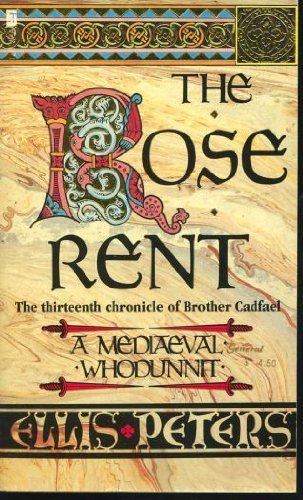
The Rose Rent - Ellis Peters

The thirteenth Cadfael novel, The Rose Rent, is a little bit more than a detective story. Young widow Judith Perle, who rents property to the abbey for the token price of a single rose delivered on the same day once every year, goes missing a couple of days before this rent is due, following the mysterious near-destruction of the rose bush in question. As the sheriff and the abbey are well aware, failed payment of this rent, would legally result in the property defaulting back to Mistress Perle, and puts suspicion on some of her would-be suitors would might aspire to own it themselves.

Ellis Peters uses more of an open style of narration than usual in this novel, and we see events from a diverse range of points of view. With an ingenuity worthy of Agatha Christie, this is cleverly used to hide facts in plain sight and to bring about a genuinely surprising ending.

The main point of this novel, for me, wasn't simply solving the original murder of a young monk found dead after defending the unlucky rose bush. It was more an exploration of grief and love, seeing the young widow begin to stop mourning her first husband and starting to move on with her life, and we see a wide selection of suitors each with their own agenda, all eager to marry into the prosperous business Judith has inherited.

Overall this novel felt more sophisticated as a plot than many of the preceding ones, and had an emotional complexity that really made it come alive.


Next up: Lullaby by Chuck Palahniuk

Saturday, 10 October 2015

Bridget Jones' Diary - Helen Fielding

I've read Bridget Jones' Diary several times before, but that was many years ago, so when I found the French translation in a bookshop in Brittany I had to pick it up. It made for much more relaxing holiday reading than the rather heavier L'Allée du Roi I'd brought with me, and I can actually claim it was vaguely educational, teaching me words for everyday things like types of modern clothing, cigarettes (ok, that one's the same) and minor swearwords, all things not often featured in more classic novels.

The translation felt pretty spot-on, keeping the tone of the original novel very well in spite of its cultural Zeitgeists, although it did have resort to footnotes to explain things such as Eastenders or Michael Howard.

One of the things I love most about this novel (as well as the plot, which as everyone knows is based on Pride and Prejudice, so not totally original to Fielding), is the down-to-earth narrator. Published nearly 10 years ago (and how old does that make me feel!), I have yet to come across another novel that feels quite as real. Nothing about Bridget is romanticised – she's no more glamorous, successful, strong or determined that your average woman, but Fielding doesn't use Stephanie Meyer's irritating wish-fulfilment trick of having the whole world fall in love with her supposedly 'average' heroine. Instead Bridget struggles vaguely through life without things falling into her lap, and not only do we as readers see the external parts of her experience - her conversations with others, dramatic scenes and so on - but we are also privy to the general grime and disorder of everyday life. For me this makes it so much more personal and relatable than reading about protagonists who never have to go to the bathroom or wash their clothes.

Of course Bridget Jones' Diary is, at heart, a romantic story, but the focus is very much on a humorous retelling of the problems and anxieties of romance rather than being swept off your feet by a prince charming. The film is a little different from the book, having switched events round and cut a few characters out to streamline the story, and I do have a friend who said this put her off reading the book afterwards, but I really recommend it personally if you're a fan of the film but haven't yet read the book.

Next up: Thank You, Jeeves by P G Wodehouse

Thursday, 20 August 2015

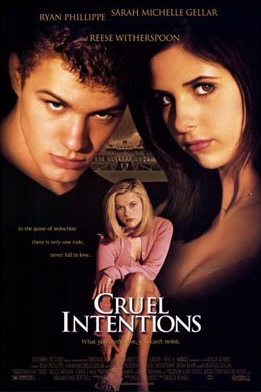
Film adaptation - Cruel Intentions

I decided to begin my trio of Les Liasons Dangereuses adaptations with the most approachable and probably best-known adaptation, Cruel Intentions. I did watch it once before, many years ago, but had almost entirely forgotten it since.

Obviously Cruel Intentions is very a modern retelling of the novel rather than a straight-up adaptation, so I wasn't sure how faithful it would be. I was surprised how well the general atmosphere and the concept of the story translated from idle French aristocracy to overprivileged American teenagers, and while several of the characters' relations to each other had to be altered to fit with the new social structure, the characters themselves were mostly very accurately transferred.

I did wonder how well the necessary flattening of the age differences would work (most notably the difference between Cécile and Danceny compared to Valmont and the Marquise), but actually the difference in their characters' relative life experiences in the film made it very successful. The setting of the overdecorated, faux-historical houses really captured the sense of corrupt decadence of the original novel.

One thing that I felt was a shame was that the Marquise (or Kathryn) was turned into such a clear-cut villain. I loved the fact that in the original novel there was such moral ambiguity, and to me the Marquise de Merteuil felt like an intelligent, independent (but admittedly very selfish) woman bored out of her mind by the constricted, idle role forced on her by society. Kathryn actually explicitly makes this point in the film (“God forbid, I exude confidence and enjoy sex! Do you think I relish the fact that I have to act like Mary Sunshine 24/7 so I can be considered a lady?”), and this very effectively sums up the double standards between genders present in both the original novel and the modern adaptation. Cruel Intentions, however, by making Kathryn such an obvious villain, manages to undermine this protest against ingrained gender roles and makes it part of being a bad female role model. (That's my opinion anyway, but I did have a real soft spot for the Marquise in the novel so perhaps I'm reading too much into it!)

The ending of the film was much lighter than the ending of the novel, although I was impressed by the fact that they did commit to keeping one death in, which gave the ending much more impact and poignancy than the majority of American teen dramas.

Overall, I really enjoyed it, and was pleasantly surprised how faithfully the novel was adapted. A great film even if you haven't read the book.

Sunday, 16 August 2015

Les Liaisons Dangereuses - Pierre Choderlos de Laclos

I really enjoyed this novel from the very beginning. The moral ambiguity of each character and the focus on concealment and manipulation make each individual into a fascinating character study, and the fact that the story is told through letters allows each person's differing viewpoints on the same events to shine through. The correspondence between various members of a connected group gradually builds up into a complex web of interdependent relationships, binding the characters' futures together.

In spite of what feels like an obligatory moral message at the close of the novel, there is a joy and humour in the machinations of the central characters, the Vicomte de Valmont and his ex-lover the Marquise de Merteuil. Their charisma and the genuine affection in their letters to each other, if to none of the other characters, makes it impossible to dislike them however badly they act, and although they are the two pivotal characters, the more minor characters are also given enough space to feel real in their own right.

This is a surprisingly unpredictable novel, full of human complexity and lightened with flashes of humour and irony. Very much worth reading, and I have a few film adaptations ready to watch now I've finished it.


Next up: Death of an Avid Reader by Frances Brody

Monday, 22 June 2015

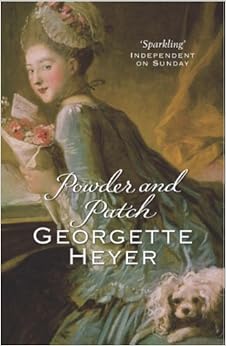
Powder and Patch - Georgette Heyer

In this short romantic comedy, Philip Jettan, heir to a country estate, is told by his childhood sweetheart that he is too unsophisticated and boorish, and that he must go to town to become a real gentleman or she will not have him. Reluctantly he travels to Paris, where (somewhat implausibly) he takes naturally to French fashion and court gentility and is a great social success. On his return, his beloved Cleone barely recognises the new, polished Philip, and he has to win her approval all over again.

Although rather a contrived, unconvincing plotline, Powder and Patch is full of witty dialogue and has some very funny scenes, particularly with the role-reversal of the couple when Philip returns to England. Heyer's usual warmth and humour brings the characters to life and makes them all likeable and enjoyable to read about.

An amusing little novel, great for picking up if you fancy something light and quick to read.


Next up: Stephen Fry in America by Stephen Fry

Sunday, 31 May 2015

Film adaptation - Poldark

In terms of accuracy to the novels, I can only comment as far as the first half of the TV series is concerned, as it seems to cover both Ross Poldark and Demezla, and I haven't yet read the second novel in the series.

The casting didn't exactly fit the characters' appearances as described in the novels – Ross' eyes and Elizabeth's hair were the wrong colour, and I think Eleanor Tomlinson is far too naturally pretty for Demelza - it looked like they had to try quite hard to make her unattractive for the first few episodes. However, the actors played the parts incredibly well, and I soon forgot about the physical differences. I also really liked the fact that the supporting cast playing the poor villagers and the miners actually looked unhealthy, dirty and poor, including Demelza to begin with.

It felt to me as though they'd lost much of the moral ambiguity of the novels, and made more of a 'heroes against villains' feeling with Ross and Demelza on one side and the Warleggan family on the other. In the first novel at least, both Ross and Demelza (who are point-of-view characters) are, although well-meaning, clearly flawed individuals, and George Warleggan is portrayed as nothing worse than a rather selfish, bourgeois rising businessman. The subtle dynamics of Elizabeth and Demelza's relationship were portrayed well, however, as was Ross' incessant brooding (Aidan Turner really does have a fantastic brooding face).

The Cornish scenery was beautifully shot and lent a stunning backdrop to the story, and the house interiors felt solid, dark and lived-in. The soundtrack was also beautiful and evocative. Overall, a surprisingly faithful adaptation of a poignantly human story. Well worth watching if you like period dramas.

Sunday, 17 May 2015

Bridget Jones: Mad About the Boy - Helen Fielding

I was a little dubious about a Bridge Jones sequel about her being aged 50 or so, and having finished the novel I'm still not quite convinced.

For one thing, we begin with a narrative voice that feels identical to Bridget in her 30s, and while her naivety and social ineptness were amusing and plausible in her younger incarnations in Bridget Jones' Diary and Bridge Jones: The Edge of Reason, her inexperience sits badly on a woman in her 50s. I found that I was too young to relate to some aspects of the story, and never having had children also meant that I'd only ever experienced the child-related parts as a child – not that that's an inherent criticism of the novel, just that I personally didn't get as much from it as I might have done.

I felt quite uncomfortable throughout with 20-year age gap between Bridget and her new boyfriend Roxter, and it seems to me very convenient (and frankly unrealistic) that she is now so rich she never needs to work except as a hobby.

On the plus side, Mad About the Boy had more depth and poignancy to it, as it showed the changes (some very sad) that had taken place in the lives of the characters in the 15 years that had passed since the last instalment. There are many genuinely funny moments to balance out the melancholy, and as well as a romantic comedy this is about a woman coming to terms with age and beginning to accept herself as she is.

So mixed impressions overall, but I did enjoy reading it for the most part, and by the end was thoroughly heart-warmed and cried a little bit.


Next up: Lamentation by C J Sansom

Saturday, 28 February 2015

The Adventures of Sally - P G Wodehouse

My only experience so far of P G Wodehouse has been the Jeeves and Wooster series, and unusually for me I actually preferred the TV series, finding the books a little too meandering and vague.

I'm glad I gave this one a chance, though. While it did wander along at a gentle pace and the viewpoints switch casually around, it's full of humour and light-hearted satire.

Our heroine, a young New York girl by the name of Sally, comes into a minor inheritance, and decides to take a holiday in Europe before settling sensibly into some investment or other. While in France she meets the inept but warm-hearted Ginger and his austere cousin Bruce, who continue to dog her existence when she returns home.

The moments of unexpected human comedy and the feeling of joie de vivre that pervades the whole story make this a book that you look forward to picking up.

Maybe it's time to get hold of some Jeeves and Wooster and give the novels another chance.


Next up: Ross Poldark by Winston Graham

Friday, 13 February 2015

The Heart of a Hospital - Anne Vinton

As it turns out, it's nearly Valentine's Day, and by coincidence I have an appropriate trashy romance to review. This being a hospital-themed one was particularly amusing, as I've just started a new job up on the wards myself.

The beautiful, young, intelligent, serene, womanly, etc. Sister Eve Ramsey (in spite of her incredibly craggy illustration on the cover) is delighted to have just become secretly engaged to an almost-qualified young doctor. She loves her job, and in fact "always felt a heart-warming sensation as she opened the ward doors for the first time each day. It was as though she loved every patient there, and they in return watched for her appearance and sent out the warmth of their loving gratitude to her." The NHS has certainly changed in 65 years.

Eve's unruly and selfish half-sister arrives to work in her hospital, and a new patient, handsome, well-known (and heir to a baronetcy, naturally) also arrives. The plot unfolds with inevitable predictability and implausibility, our heroine is described as a ministering angel by almost anyone who knows her (and the others are of course just jealous), and her womanly compassion and patience win her romance and wealth and titles and all of the other things women could ever want.

Highly amusing and with several inadvertent laugh-out-loud moments. If you're ironically into vintage trashy romances (I hope it's not just me!) this is well worth a read.


Next up: A Corpse at St Andrew's Chapel by Mel Starr

Saturday, 6 September 2014

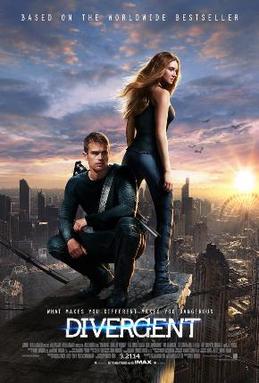
Film adaptation - Divergent

I quite enjoyed reading Veronica Roth's Divergent, so had pretty high hopes for the film. I'm glad to say that these were mostly justified - while the film did cut out some of the brutality of the book (for instance the initiate falling to their death early on), for the most part it stayed true to the plotline and the atmosphere of the novel.

It really brought to life the melancholy beauty of the destroyed landscapes being reclaimed by nature, and while much of the film took place in underground tunnels, we see enough of the outside world not to get bored of the setting. The central character, Tris (played by Shailene Woodley) does, in the usual hollywood fashion, remain pretty even after being horribly beaten up, only the odd painted-on bruise remaining. It was nice, however, to see that she didn't cry attractively - why shouldn't people in films have distorted, crumpled faces and hoarse nasal voices when they cry, as well as real life? That made the sad parts all the more touching, for me, to see a more realistic expression of grief.

The action was well-paced, and the film stuck well to the book - losing some of its depth due to time constraints, but that's always a problem. Well worth a watch, if you enjoyed the book.

Sunday, 17 August 2014

Film adaptation - City of Bones


This is one of those unusual times when I felt that the film adaptation was actually much better than the book. I read Cassandra Clare's City of Bones some years ago – I liked the cover art and was going through a bit of an urban fantasy phase at the time. I really didn’t enjoy it, however. I found Clary’s narrative voice bratty and irritating, and most of the plotline rather clichéd.


The film was much better because I didn’t have to listen to Clary Fray’s internal monologue, and of course anything is improved by the addition of Lena Headly and Robert Sheehan. Admittedly some of the special effects were a bit naff, but on the whole it felt much faster-paced and less whiny than the novel, and despite quite a lot of awkward eye contact moments it got pretty gripping by the end. Plus the entire cast’s magnificent cheekbones don't hurt.

Sunday, 10 August 2014

Graceling - Kristin Cashore


Graceling came with the rather dubious recommendation, “[This] exquisitely drawn romance … will slake the thirst of Twilight fans”, on the front cover. However, I really enjoyed Fire, so I went ahead and read it anyway.

While it doesn’t quite have the accomplished sense of depth of Fire, this is Cashore’s debut novel, and as such that’s simply a sign that her novels have developed since the beginning. She does a good job of introducing us to the fantasy world the story takes place in, without being artificially explanatory or giving us too many made-up terms to try and remember.

The heroine, Katsa, is a graceling, marked out by her mismatched eyes and an uncanny natural ability – in her case, the ability to inflict violence. Ever since her gift was discovered, her uncle the King has been using her as a tool of intimidation against those who displeased him. A chance to investigate the mysterious kidnapping of a neighbouring King's father offers her an opportunity to escape and to prove to herself and others that she’s more than just a mindless thug.

One of the things that really stood out about this novel was the unusual angles we see events from. Katsa is an unconventional young woman, but this is only to be expected as the heroine of a young adult fantasy novel. However, the feel of the narrative is also different – while the novel appears to be of the standard ‘vanquish the villain’ type, you get the feeling that defeating the bad guy wasn’t really what it was all about.

The Twilight-style epic romance promised on the cover was, thankfully, more human and believable than that, albeit made more complex by the respective graceling abilities of the pair involved. This novel is populated by strong characters throughout, and we also meet Princess Bitterblue, the protagonist of the third and final novel in the trilogy. Despite being a child, she's forthright and intriguing, and I’m really looking forward to reading more about her.


Next up: The Unquiet Bones by Mel Starr

Monday, 28 April 2014

Cousin Kate - Georgette Heyer


This is an odd one, because it’s historical fiction, written almost 50 years ago. Part of me thought that it might closely resemble modern historical fiction, but that part of me was wrong.

Nowadays historical fiction often tries to focus on realism, on capturing the mindset and atmosphere of the people living at the time. Heyer, however, simply transplants a plucky 60s young woman into the nineteenth century, making her an unfeasibly attractive and outspoken penniless governess. Kate is invited to stay with her rich aunt Lady Broome and her admittedly odd cousin, Torquil, and discovers various dark family secrets along the way.

Virtually every character in this novel speaks in a bizarre kind of slang, which I initially assumed was common 60s slang, but The Sunday Times claims that it is “slang beautifully rendered” – presumably regency slang, or the contemporaneous idea of it. Having lived through neither the regency period nor the 1960s, I can’t say for sure, but it feels a bit jarring to me.

That said, it’s an amusingly melodramatic romance, and a fun light read.

Next up: The Way of Shadows, by Brent Weeks

Wednesday, 2 April 2014

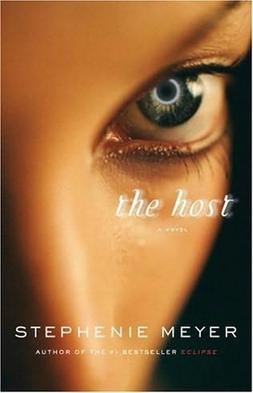
The Host - Stephenie Meyer


I don’t normally like to post mean reviews, but at this point I think Stephenie Meyer is rather too rich to
care, and is probably quite used to receiving hate mail as well as the locks of hair and used underpants belonging to overexcited and slightly confused young women who think she keeps Edward Cullen somewhere on her person.

Admittedly, The Host is better than Twilight. Significantly better, in fact. The plot actually sounds promising: an alien invasion by parasitic creatures that attach to the spines of their hosts and continue to live their lives as normal until virtually the whole planet is taken over, leaving only tiny pockets of still-human resistance. The narrative is told by one of the alien consciousnesses themselves, which is also an interesting concept.

However, it’s at this point that promising sci-fi originality goes out of the window and Meyer’s compulsion to turn everything into a vapid teen romance steps in. Instead of choosing one of the many interesting potential avenues, Meyer focuses on our alien protagonist Wanda and her human host Mel’s inner girlish arguments, and on the fact that Wanda appears to have inherited Mel’s love interest in her boyfriend Jared.

Wanda decides to search for Jared and her brother Jamie, who are sheltering in a cave in the desert. She’s taken prisoner by the community Jared and Jamie have joined, and, now that Mel’s been taken over by the enemy, Jared is full of hatred for her and immediately proclaims that she should be killed. Although Wanda and Mel manage to gradually win over the trust of most of the community, Jared is staunch in his opinion, and even hits her several times, giving her noticeable injuries and facial scarring. She continues to try and gain his trust by putting herself last in everything and generally acting like a doormat, refusing to stand up for herself even to save her own life. Just as women should do in the face of domestic violence, apparently. Thanks for that, Meyer.

Despite the advances of attractive nice guy Ian, who has come to like Wanda for who she is now rather than Mel as she was previously and acts as protector and comforter to her, both Wanda and Mel cling to their desperate love for the man who quite literally wants to murder them for the majority of the novel. I was worried, given the fact that virtually the same situation happens in Twilight (ie. Edward literally wanting to kill Bella most of the time, and I’m-your-totally-platonic-friend Jacob doing everything for her and being off-handedly rejected for not being her true love), that the Wanda-Mel composite would end up somehow living happily ever after with the violent unpleasant Jared.

However, after telling her that, “You are the noblest, purest creature I've ever met. The universe will be a darker place without you,” (a compliment she was clearly fishing for from the very beginning of the novel), her friends collude to transplant her consciousness into a vacant body (another young, attractive female, obviously), conveniently saving her the trouble of going through with her difficult decision to leave Mel her own body back at Wanda’s expense. Wanda and Ian can live happily ever after, and Mel is lucky enough to have her boyfriend back – the one who weeks ago beat her repeatedly and wanted to kill her. Lucky, lucky Mel. But apparently he’s hot, so that’s what matters.

So, um, yes. Always submit meekly to your one true love, even if he beats you and threatens to kill you, and everything will be ok, until you… get transplanted into someone else and can have the nice guy? I’m still quite confused about the message I’m getting from this one.


Next up: Heartstone, by C J Sansom