Sunday, 14 September 2014

The Girl who Played with Fire - Stieg Larsson


I don’t normally go for novels written about the present-day, but Stieg Larsson’s Millennium trilogy really is outstanding.

Even in translation, Larsson’s writing is clear, concise and driven. Intriguing hints and new twists combine deftly with touching moments and action-packed scenes, making it one of those books where ‘just one more page’ becomes another hour. The only criticism I have is that the writing style stays exactly the same even when we switch point of view characters, but each character still stands out as an individual, and it’s quite possible that some subtle differences were lost in translation.

In this, the second novel of the trilogy, the focus moves closer to home – to Stockholm, where both Mikael Blomkvist and Lisbeth Salander live. When Salander becomes the suspect in the investigation of a multiple murder, the police and the press begin to dig into her private life and her past, and we, the reader, discover some of what happened to make her the unique and contradictory heroine she is.

The combination of bleak isolation and desperate empowerment contained within this novel is very compelling, and makes the trilogy utterly memorable and definitely well worth reading.


Next up: The Winter Garden Mystery by Carola Dunn

Saturday, 13 September 2014

Just a few more...

It being the weekend, I thought I might go out and do a bit of shopping. The results were pretty successful by my standards, consisting of a jumper for £1 and the following books, for just under £7:

Den of Thieves by David Chandler
The Shadow of the Wind by Carlos Ruiz Zafón
One Day by David Nicholls (I know this is meant to be quite a soppy one, but I thought Starter for Ten was pretty outstanding in its way)
A Parliament of Spies by Cassandra Clark
The Winter Garden Mystery by Carola Dunn
Pure by Andrew Miller

Most of these look really good, so I'm quite looking forward to getting started on them soon!

Thursday, 11 September 2014

Recommendations

This week's Booking Through Thursday is:

If a friend asks you to recommend a really good book—good writing, good characters, good story—but with no other qualifications … what would you recommend? 


I'm sorry, but there is absolutely no way I can settle for just 'good' as a descriptor - there are so many different kinds of books. I'm going to be a bit of a rebel and go through a few categories here:

Vaguely historical drama: The Crimson Petal and the White by Michel Faber and Fingersmith by Sarah Waters are both absolutely wonderful and very thought-provoking.

Fantasy: Anything in the middle-range (chronologically) of Terry Pratchett's Discworld series - most of them from Mort (1987) through to Carpe Jugulum (1998) have endless rereading appeal for me. I find his very first novels are too much parody and too little substance, and the later ones are too much like a straightforward novel to take many repeated readings. That middle range for me is the perfect balance.

Historical mystery: Ellis Peters' Cadfael series, and C J Sansom's Shardlake series. The Unquiet Bones is amazing too.

Modern thriller: Stieg Larsson's Millennium trilogy (of which I'm currently reading the second novel) is great so far - gripping, intense and very clever.

'Real' historical novels (as in written a couple of hundred years ago+): Vanity Fair by William Makepeace Thackeray and all of Charlotte Brontë's novels are so poignant in their sense of human nature, as is Jane Austen's Persuasion. If you're looking for something lighter, Austen's other novels or Henry Fielding's works are perfect for an amusing social critique.

I'm sure there are infinitely more amazing books that I've missed off here, but those are the main ones off the top of my head. If you have any recommendations please let me know below - I'm always excited to find new novels!

Tuesday, 9 September 2014

The Diary of a Provincial Lady - E M Delafield


If Bridget Jones had been a 1920s housewife, this would be her. The fictional diaries of the unnamed Provincial Lady document the daily life of the well-intentioned, self-conscious and scathingly sarcastic narrator. We are shown her family life in a small village in Devon, and in the sequels follow her on a tour of America and to London during WWII.

While not very much “happens”, as such, the wonderful turns of phrase and the diarist’s acerbic observations on human nature had me sniggering rather loudly in the canteen at work. My boyfriend picked it up at one point, glanced down the page and asked me when it was written. When I told him the 1930s, he said that he hadn’t realised people were so sarcastic in those days.

The Diary of a Provincial Lady defies the common preconception that older books tend to be quite polite and sedate, and instead looks with a keen sense of the ridiculous at peoples’ everyday habits and tendencies. A cleverly written series of books that have the feel of sitting down for a cup of tea and a gossip with an old friend - perfect for curling up with at the end of a long day.


Next up: The Girl Who Played with Fire by Stieg Larsson

Monday, 8 September 2014

School Discoveries

This week's Booking Through Thursday is:

We all had to read lots of different things in school—some of which we liked, some of which we didn’t. Are there any authors that you’ve grown to love because you were introduced to them in your English Lit class? Or—the contrary. Are there any you hate because you were forced to read them? Did you ever go back to try them again?

Honestly? No, I don't think any of the set texts during school or university made me fall in love with the authors and seek out more of their work. In a way it was the opposite - I was really put off Susan Hill because we had to read I'm the King of the Castle, which not only was very depressing but also was read aloud by class members in excruciatingly small doses, when I'd already taken the book home and finished it after the first week. I read The Woman in Black years later and actually rather enjoyed it (even though the recent film terrified me, and its deviation from the plot annoyed me too), and have The Risk of Darkness on my shelves for later.

A similar thing happened with Margaret Attwood. We had to read Surfacing at college, which I found bizarre and boring in equal measure. I read The Blind Assassin a couple of years ago, though, and loved it - I felt connected to the characters, they felt like human beings I might want to know, and it was very cleverly written. Several of her others sound very interesting, and I'd especially like to read The Handmaid's Tale when I can get hold of a copy.

I've already mentioned my dislike of Virginia Woolf in another post, and even when we were lucky enough to be given set texts I enjoyed, I can't help feeling that in the majority of cases having to dissect them clinically and write essays or exams on them ruins your love for a book.

Sunday, 7 September 2014

A substantial addition


Thanks to a combination of some books passed on to me by a friend, and a totally necessary visit to an Oxfam bookshop on the way back to the station, my trip to Bath yesterday has increased by collection quite a bit. Plus I got to eat a meringue the size of my face - always a bonus.

Today's haul consists of:
The World According to Bob by James Bowen
An Arsène Lupin Omnibus by Maurice Leblanc
Armadale by Wilkie Collins (the only fictional novel by him that I haven't read yet, I think)
Parker Pyne Investigates and The Seven Dials Mystery by Agatha Christie
The King's Evil and The Repentant Rake by Edward Marston
Cool Repentance by Antonia Fraser
Scorn with Added Vitriol by Matthew Parris (I was disappointed to find out that it wasn't written by this one)
The first 3 novels in the Poldark Saga by Winston Graham
The Herb of Grace by Elizabeth Goudge
A Twist of Fate by Joanna Rees
The Secret Between Us by Louise Douglas
All Manners of Food by Stephen Mennell (a history of food and tastes throughout the ages, apparently)

Not bad - a bit of a random selection, but the majority were free and there's a good bit of detective and historical stuff in there.

Saturday, 6 September 2014

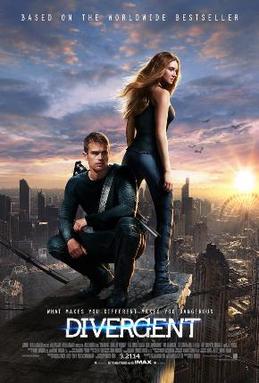
Film adaptation - Divergent

I quite enjoyed reading Veronica Roth's Divergent, so had pretty high hopes for the film. I'm glad to say that these were mostly justified - while the film did cut out some of the brutality of the book (for instance the initiate falling to their death early on), for the most part it stayed true to the plotline and the atmosphere of the novel.

It really brought to life the melancholy beauty of the destroyed landscapes being reclaimed by nature, and while much of the film took place in underground tunnels, we see enough of the outside world not to get bored of the setting. The central character, Tris (played by Shailene Woodley) does, in the usual hollywood fashion, remain pretty even after being horribly beaten up, only the odd painted-on bruise remaining. It was nice, however, to see that she didn't cry attractively - why shouldn't people in films have distorted, crumpled faces and hoarse nasal voices when they cry, as well as real life? That made the sad parts all the more touching, for me, to see a more realistic expression of grief.

The action was well-paced, and the film stuck well to the book - losing some of its depth due to time constraints, but that's always a problem. Well worth a watch, if you enjoyed the book.