Showing posts with label Helen Fielding. Show all posts

Saturday, 10 October 2015

Bridget Jones' Diary - Helen Fielding

I've read Bridget Jones' Diary several times before, but that was many years ago, so when I found the French translation in a bookshop in Brittany I had to pick it up. It made for much more relaxing holiday reading than the rather heavier L'Allée du Roi I'd brought with me, and I can actually claim it was vaguely educational, teaching me words for everyday things like types of modern clothing, cigarettes (ok, that one's the same) and minor swearwords, all things not often featured in more classic novels.

The translation felt pretty spot-on, keeping the tone of the original novel very well in spite of its cultural Zeitgeists, although it did have resort to footnotes to explain things such as Eastenders or Michael Howard.

One of the things I love most about this novel (as well as the plot, which as everyone knows is based on Pride and Prejudice, so not totally original to Fielding), is the down-to-earth narrator. Published nearly 10 years ago (and how old does that make me feel!), I have yet to come across another novel that feels quite as real. Nothing about Bridget is romanticised – she's no more glamorous, successful, strong or determined that your average woman, but Fielding doesn't use Stephanie Meyer's irritating wish-fulfilment trick of having the whole world fall in love with her supposedly 'average' heroine. Instead Bridget struggles vaguely through life without things falling into her lap, and not only do we as readers see the external parts of her experience - her conversations with others, dramatic scenes and so on - but we are also privy to the general grime and disorder of everyday life. For me this makes it so much more personal and relatable than reading about protagonists who never have to go to the bathroom or wash their clothes.

Of course Bridget Jones' Diary is, at heart, a romantic story, but the focus is very much on a humorous retelling of the problems and anxieties of romance rather than being swept off your feet by a prince charming. The film is a little different from the book, having switched events round and cut a few characters out to streamline the story, and I do have a friend who said this put her off reading the book afterwards, but I really recommend it personally if you're a fan of the film but haven't yet read the book.

Next up: Thank You, Jeeves by P G Wodehouse

Saturday, 3 October 2015

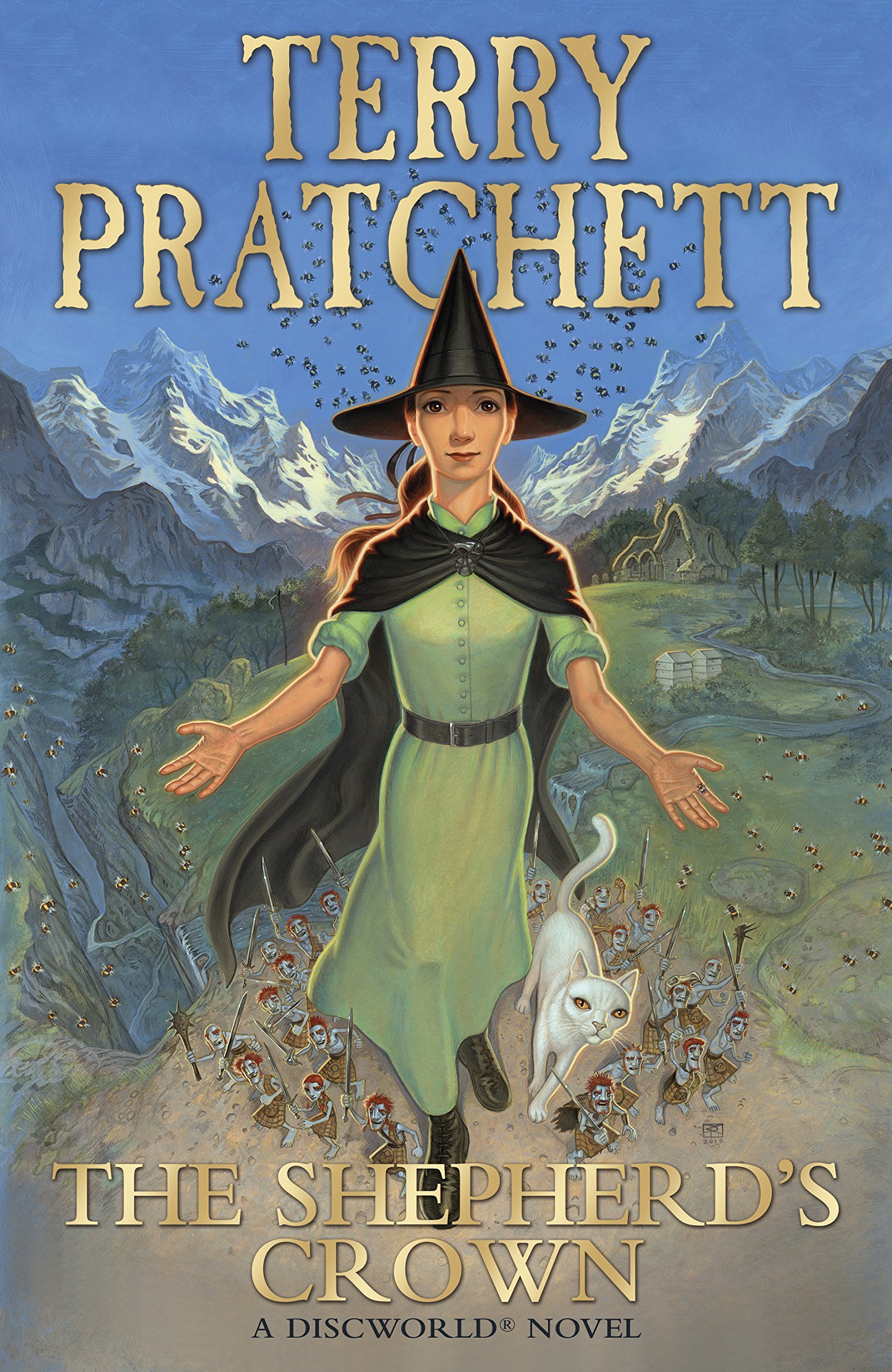
Bonus review: The Shepherd's Crown - Terry Pratchett

This afternoon I took Terry Pratchett's last novel, The Shepherd's Crown, to a café (accidentally buying 3 more books on my way into town), and finished it in 3 hours.

This novel follows Tiffany Aching as she comes into her own as a professional witch and has to face up to the increase in responsibility that entails, as well as another threat of elven invasion.

I don't want to give spoilers to anyone who hasn't read it, but I will say there's a major character death, which feels so autobiographical, almost as though it's Pratchett's own goodbye to the world, that it really was very moving above and beyond its implications for the character within the novel.

The Shepherd's Crown is full of a joy of life and an optimism about human nature, with laugh-out-loud moments and some truly wonderful awful puns. It feels much better put-together than a few of his later works, which for me felt as though they were lacking in structure, whereas this one feels like one complete story in its own right. There are a few loose ends, which is unsurprising for a posthumous publication, but overall it was a fantastic read, a good balance of plot, humour and pathos.

Now that I've finished it it's occurred to me that I'll never again be able to read a new Pratchett novel, and that makes me very sad indeed.


Next up: Bridget Jones' Diary by Helen Fielding

Tuesday, 15 September 2015

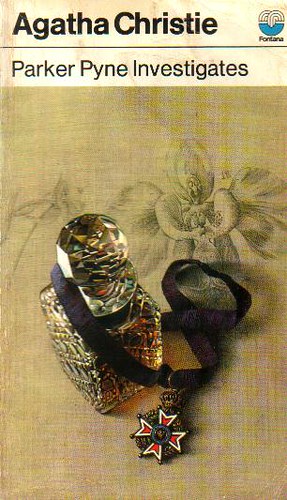
Parker Pyne Investigates - Agatha Christie

Parker Pyne Investigates is more a series of short stories than one novel, featuring Mr Parker Pyne, an ex-statistican who now consults for a living. He claims not to be a detective, and in fact he's almost the opposite of a detective – people come to him unhappy from insecurity in their marriage, dissatisfaction with their lifestyle, or simply out of boredom – and he secretly engineers events which push them in the direction of becoming happier.

The first half of the book has a collection of these 'consultation' stories in London, but the second half follows Mr Parker Pyne on a series of travels around the Middle East, Egypt and Greece, in which he finds himself reluctantly pulled into playing the detective even on holiday.

As a character Parker Pyne feels like a cross between Poirot and G K Chesterton's Father Brown. His apparently haphazard methods and understanding, stolid manner almost always lead to him succeeding somehow, and he takes success or the occasional failure with the same amiable placidity.

This collection of short stories feels almost like an artist's sketchbook, where an idea or concept for one of Christie's more complex plots is briefly sketched out and played with to explore its potential. The stories are amusing, ironic and full of trademark twists and good-humoured melodrama.

Overall, a light, pleasant read for any mystery fan.


Next up: Bridget Jones' Diary by Helen Fielding

Sunday, 17 May 2015

Bridget Jones: Mad About the Boy - Helen Fielding

I was a little dubious about a Bridge Jones sequel about her being aged 50 or so, and having finished the novel I'm still not quite convinced.

For one thing, we begin with a narrative voice that feels identical to Bridget in her 30s, and while her naivety and social ineptness were amusing and plausible in her younger incarnations in Bridget Jones' Diary and Bridge Jones: The Edge of Reason, her inexperience sits badly on a woman in her 50s. I found that I was too young to relate to some aspects of the story, and never having had children also meant that I'd only ever experienced the child-related parts as a child – not that that's an inherent criticism of the novel, just that I personally didn't get as much from it as I might have done.

I felt quite uncomfortable throughout with 20-year age gap between Bridget and her new boyfriend Roxter, and it seems to me very convenient (and frankly unrealistic) that she is now so rich she never needs to work except as a hobby.

On the plus side, Mad About the Boy had more depth and poignancy to it, as it showed the changes (some very sad) that had taken place in the lives of the characters in the 15 years that had passed since the last instalment. There are many genuinely funny moments to balance out the melancholy, and as well as a romantic comedy this is about a woman coming to terms with age and beginning to accept herself as she is.

So mixed impressions overall, but I did enjoy reading it for the most part, and by the end was thoroughly heart-warmed and cried a little bit.


Next up: Lamentation by C J Sansom

Monday, 11 May 2015

The Chronicles of Thomas Covenant, the Unbeliever - Stephen Donaldson

It's taken me a long time to finish, but it was worth every minute. On the cover, The Chronicles of Thomas Covenant, the Unbeliever is described as a “classic epic fantasy trilogy”, but it's so much more than that. Yes, it is an epic fantasy, with rolling hills, suspiciously elf- and dwarf-like human tribes, giants, orc-like twisted creatures of evil, and learned Lords who wield magical staves. I expected that much from the cover and blurb.

However, the first chapter begins with Thomas Covenant, previously successful author with wife and child, who was recently diagnosed with leprosy and as a result lost his family, his respect and his health. We have an incredibly vivid and moving account of the discovery of his disease and his sudden change to pariah in his own home in small-town America. It isn't until Covenant is hit by a police car and concussed that the 'fantasy' part of the story begins.

Covenant was warned on diagnosis that many lepers retreat into self-induced hallucinations to try and escape from the harsh reality of his disease, and so when he is plunged into a fantastic, beautiful land where his nerves are healed and he can function as a healthy adult once more, he doesn't believe any of it. One of the most fascinating aspects of this trilogy is the narrative viewpoint – instead of a hero, or even an anti-hero, we have almost a non-participant, a man who doesn't believe that any of what he's experiencing is real. Another thing that really sets The Chronicles of Thomas Covenant apart is the psychology of disability, which is so deeply and accurately portrayed; the foreword tells us that Stephen Donaldson's father worked with lepers in India in the 1940s and 50s, and that the author lived with him as a child when he was performing this work. His personal knowledge of the subject is obvious from the poignant, nuanced but brutally honest portrayal of Covenant's leprosy.

Gender equality was an unexpected but pleasant surprise, too. In most male-written fantasy universes sexual division is rife, but in The Land the council of elders who form a kind of parliament are all referred to as 'Lords', regardless of their gender. Similarly, when a couple marries, the wife takes the husband's name, but the husband also takes the wife's name – for instance, one couple Covenant meets are named Trell Atiaran-mate and Atiaran Trell-mate. Women are expected to be just as competent as men, and in fact the High Lord who leads the council in the second novel is a relatively young woman who is respected for her personal abilities.

Donaldson's unusual use of adjectives gives a lurid, dreamlike quality both to the fantasy Land and to the real-life sections, and he describes scenes using all of the senses, including touch, smell and taste, not just sound and vision. He builds a world rich with detail and background lore, my only criticisms being that he uses certain odd adjectives a little too often so that they start to jar ('extravagantly' and 'anile' being a couple of examples) and that I find his characters' habit of bursting into song or poetry during solemn, ceremonial occasions a little cringe-worthy.

That said, this is a story full of contradictions and moral ambiguity, and Donaldson is a master of the cliff-hanger chapter – many times when reading this I decided to just finish the current chapter and put it down, but found myself compelled to continue to find out what happened. I can't recommend this too highly – it has so much more depth and poignancy than your average fantasy novel, and is a very good epic fantasy story on top of that.


Next up: Bridget Jones: Mad About the Boy by Helen Fielding

Friday, 21 March 2014

Re-reading books

This week's Booking Through Thursday is:

I’ve asked before if you re-read your books (feel free to recap), but right now I want to know if that habit has changed? Did you, for example, reread more as a child and your access to new books was limited by how often you could convince your mother to take you to the library? Has the economy affected your access so that you’re forced to reread more often now? Have you grown to look at old books as old friends so that you’re happy to spend time with them rather than rushing the next new thing?

I suppose I now reread books less often than when I was a child, because I do have a lot more new books to read. I still have old favourites I like to return to occasionally (mainly Jane Austen, Terry Pratchett and Helen Fielding), but for me the magic of reading mostly lies in exploring new worlds. I enjoy returning to Austen and Fielding because of the comfort the stories bring, but with Terry Pratchett's best work (in my opinion, the middle range of his novels, rather than the earliest or latest) you notice new jokes and amusing turns of phrase each time you read them, the same way a beloved comedy series gives you something new to laugh at every time you rewatch an episode.

How about you? Do any of you like to reread books, and if so which ones?