This week's Booking Through Thursday is:
Do you like to read books about far-away places? Travel guides, memoirs,
whatever? Places you’ve been? Or places you’ve never been?
That's a good question, but... no. I don't, I don't tend to read books based on real life in general, and I never read straight-up travelogues. I'll only read biographies if it's someone I'm really interested it.
I guess the easiest answer as to why is that I read for escapism, and that reading about real life doesn't feel like I'm escaping, even real life lived in a country I've never visited.
I do however, love to read books about places far off in history, whether long ago or potentially in the future, or about fantasy or science-fiction universes that will never exist. I know that reading for escapism should allow for reading non-fiction about places that exist right now, but somehow that just doesn't interest me as much as reading about places that I'll never see.
Showing posts with label non-fiction. Show all posts
Showing posts with label non-fiction. Show all posts
Sunday, 30 August 2015

Saturday, 8 August 2015
Stephen Fry in America - Stephen Fry
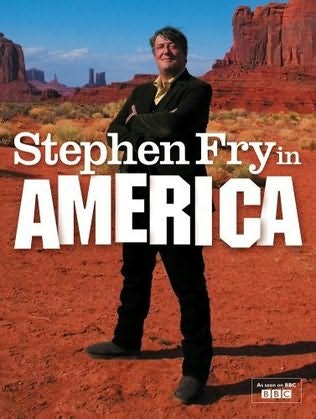
Even though I didn't catch the BBC TV
series this book is supposed to accompany, I didn't find it lacking
because of this. The general tone is anecdotal and amusing, like an
old friend telling stories of his holiday, and Stephen Fry manages to
be honest even about the negatives while remaining warm and generally
complimentary.
The book is divided into a chapter for
each state, and the photos and short sections make it more
approachable and fun than a weighty encyclopaedia of travel
knowledge. Of course with such a vast and diverse area to cover, some
states aren't as in-depth as they might be, but a general overview is
always given, alongside more personal experiences in each state.
I've always found it difficult to
imagine such a large country as the USA functioning as one entity,
and this book really made me appreciate how different each state is
in its interests, attitudes and physical landscapes. This is a proper
coffee-table book, entertaining and easy to dip into.
Next up: Les Liaisons Dangereuses
by Pierre Choderlos de Laclos
Sunday, 21 June 2015
The Definitive Guide to Screenwriting - Syd Field
I began this book completely uneducated
as to screenwriting – I'd watched and enjoyed films, but had no
idea what went into the process of crafting them. Field starts out by
explaining the basics of film structure and theory (very useful if,
like me, you're a total beginner), then goes on to dedicate
individual chapters to specifics like character, plot, and each
section of the film. He finishes by explaining the process of turning
a freshly-written screenplay into an eventual film, which again was
very useful new information for me.
Field has an open, conversational style
that makes for approachable reading and ease of understanding. I did
find that some points felt rather laboured, and that he takes a
rather didactic tone (sometimes it felt like I was being told what to
think and feel, as well as what to do, during the screenwriting
process), but on the whole this was very engaging and pleasant to
read considering it is, essentially, a textbook.
As my own background is in literature, it
was especially interesting for me to see the very different methods
by which a screenplay must tell a story – by showing only the
external, in particular tiny details that would be implicit in a
novel – as opposed to the forms I'm more used to, where the reader
is usually privy to what goes on in the protagonist's head, and any
external cues we're given are those perceived specifically by that
character.
I couldn't help but feel a bit annoyed
by Field's assertion that for a film adaptation of a novel “you are
not obligated to remain true to the original material.” I can see
that there are great challenges involved in transferring a story from
one medium to another (more than I'd appreciated before reading this
book), but I, and probably many others, are familiar with that sense
of disappointment that comes when you see a much-anticipated screen
adaptation of a beloved novel and it just isn't the same, it doesn't
capture what you loved about the book at all. In my opinion there's
nothing wrong with a screenwriter reading a novel and feeling
inspired to write a screenplay on a similar theme – just please,
please, unless you're willing to be faithful to the original, don't
label it as an adaptation.
Next up: Powder and Patch by
Georgette Heyer
Monday, 27 April 2015
Costume and Fashion: A Concise History - James Laver

Bonus review! (The Chronicles of
Thomas Covenant, the Unbeliever,
while very good, is also extremely long, being a trilogy in one
book. A friend saw me reading it at lunch today and suggested
it might also double as a self-defense item, on the grounds that it
would probably stop a knife or bullet.)
I got this book from the library on a
whim. I've never had much interest in fashion in the modern sense,
but I find historical clothing fascinating as a part of life in
general throughout the past.
This book had a little less explanation
of the factors that led to changes in clothing than I'd hoped, but to
be fair it had a lot of ground to cover, and does actually call
itself a concise history in the title. There were brief explanations
as to motivating factors for change, and very detailed timelines with
a lot of wonderful illustrations.
Pivotal changes such as cross-cultural
invasions, trading routes, and inventions that led to changes in
clothing and fashion all link in to the developments that took place.
Although it's a lot of information to take in on casual reading (and
I have to admit I did mostly skip through the final chapter about
modern fashion and designers) I feel more as though I can watch a
period drama or look at a painting and pinpoint more exactly which
time period it presents, and know which details to watch out for.
Next up: The Chronicles of Thomas Covenant, the Unbeliever
Friday, 6 March 2015
The Assassin's Cloak
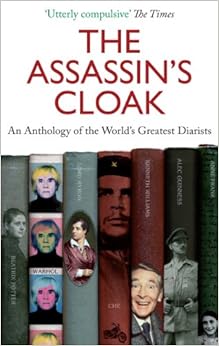
Under a disappointingly exciting title (the significance of which escapes me), this is an extensive and on the whole very enjoyable anthology of diary extracts. For each day of the year there is a collection of extracts written on that day at various points throughout history. There is also a section of brief alphabetised biographies of each person quoted, so the curious can find out some background for the quotes, followed by an index listing which dates each person appears in.
My only minor gripes are that a couple of fictional diarists are also included among the real-life ones (Adrian Mole and The Diary of a Provincial Lady), and the inconsistency in how many extracts come under each date. To be fair though, perhaps it proved difficult to find more than a few short quotes on some days, while it was easier on widely celebrated public holidays, the new year or the anniversaries of some great event to find more interesting excerpts.
The diaries come from a wide variety of people, from Samuel Pepys and Dorothy Wordsworth to Andy Warhol and Tony Benn. Particularly on days like Christmas, it's fascinating to see different peoples' reflections on the same celebrations throughout the years. Another particularly poignant aspect is the World Wars I and II diaries, especially accounts of life in the Weimar republic or in concentration camps.
A very interesting book to dip into every day, with fascinating glimpses into the lives of others throughout recent history.
Sunday, 8 February 2015
Dead Men Do Tell Tales - William R Maples
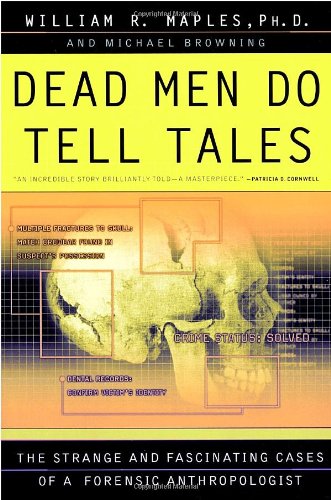
Many of the chapters are case studies on particularly intriguing historical examinations such as the Romanov massacre, the Spanish conqueror of Peru, and the elephant man, among other more modern cases, and there are photographs of some examples included. Many people might think of this as a bit macabre, but there's no pleasure taken in gory descriptions, more an academic analysis of the remains.
It sounds like a fascinating field of study, and while I don't think I'd have the stomach to actually go into it myself, it's something I hadn't realised played such a vital part in the identification of remains and the bringing to justice of the murderer. This is an informative and fascinating look at forensic anthropology, through the eyes of a talented and intelligent man. Well worth reading if you have any interest in archaology, forensics, etc!
Next up: The Heart of a Hospital by Anne Vinton
Subscribe to:
Posts (Atom)