This week's Booking Through Thursday is:
Do you read books written for children or teens? Or do you stick to books for adults?
While I do mostly ready adult fiction (and I don't mean the 50 Shades of Grey kind), I am partial to a good teen fiction novel now and again - mostly dystopias like The Hunger Games or Divergent, as I feel they still have some really interesting points to make, they're just not as dressed up in philosophy and subtlety as adult ones often are.
I'm not sure the age distinction is particularly valid, it's more about reading level and patience. Sometimes you want something a bit more direct and to the point, and a 'teen' book can be great for that. Of course there is the fact that novels with sex or a with a main romantic interest as the central theme are less suitable for pre-teens because it's not really a part of life that they understand at the time - I was reading many 'adult' standard novels by age 12 or so, and there were parts where I just didn't understand the motivation of the characters because I wasn't emotionally mature enough to do so.
So yes, if it's well written I'm perfectly happy with teen fiction, although tearing through it in a couple of days is a little less satisfying than a book that lasts a week or more.
Showing posts with label Divergent. Show all posts
Showing posts with label Divergent. Show all posts
Friday, 19 December 2014

Saturday, 6 September 2014
Film adaptation - Divergent
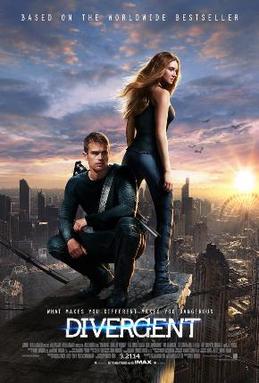
It really brought to life the melancholy beauty of the destroyed landscapes being reclaimed by nature, and while much of the film took place in underground tunnels, we see enough of the outside world not to get bored of the setting. The central character, Tris (played by Shailene Woodley) does, in the usual hollywood fashion, remain pretty even after being horribly beaten up, only the odd painted-on bruise remaining. It was nice, however, to see that she didn't cry attractively - why shouldn't people in films have distorted, crumpled faces and hoarse nasal voices when they cry, as well as real life? That made the sad parts all the more touching, for me, to see a more realistic expression of grief.
The action was well-paced, and the film stuck well to the book - losing some of its depth due to time constraints, but that's always a problem. Well worth a watch, if you enjoyed the book.
Friday, 21 March 2014
Divergent - Veronica Roth
Surprise review!
_by_Veronica_Roth_US_Hardcover_2011.jpg) I know I
said the next review would be of The
Complete Father Brown Stories, but frankly, at over 800 densely packed pages, it’s very long. I thought I’d
intersperse some light relief in the form of Divergent, the first novel in Veronica Roth’s teen trilogy.
I know I
said the next review would be of The
Complete Father Brown Stories, but frankly, at over 800 densely packed pages, it’s very long. I thought I’d
intersperse some light relief in the form of Divergent, the first novel in Veronica Roth’s teen trilogy.
I hadn’t
heard of this novel until I saw a trailer for its film adaptation in the
cinema, and had been looking out for it since. I thought the trailer looked
interesting, but a little like it was jumping on the Hunger Games bandwagon.
Divergent did remind me of The Hunger Games, but mostly in a positive sense, in that it’s a teen dystopia with a strong female protagonist. The setting is a society divided into five distinct, sequestered factions, based on primary personality traits – Abegnation for the selfless, Dauntless for the brave, Candor for the honest, Erudite for the intelligent, and Amity for the peace-loving. On reaching 16 each child undergoes a test to determine their most suited faction. While most get a distinct recommendation, Beatrice’s results are inconclusive, making her a Divergent, someone who doesn’t fit neatly into any one of the factions. She chooses to leave her family and join the Dauntless faction, and the novel follows her struggles to adapt in her new life, in a world about to fall apart.
I thought the obligatory teenage romance aspect was rather more simplistic than that in The Hunger Games, but then again I really liked the more complicated and gender-stereotype-reversing romantic situation between Peeta and Katniss, so Divergent had a lot to live up to there. In terms of grittiness, this novel got its collateral damage in almost from the beginning, and the sense that there are real consequences to the characters’ actions is with you throughout.
I felt as though I could see the larger of the plot twists coming, but was pleasantly surprised to be surprised by some of the reveals that took place. I can confidently say that, if you enjoyed The Hunger Games, you’ll like this, and I look forward to reading the other two novels in the trilogy and to seeing what they make of the film adaptation.
Next up: The Complete Father Brown Stories, by G K Chesterton
Divergent did remind me of The Hunger Games, but mostly in a positive sense, in that it’s a teen dystopia with a strong female protagonist. The setting is a society divided into five distinct, sequestered factions, based on primary personality traits – Abegnation for the selfless, Dauntless for the brave, Candor for the honest, Erudite for the intelligent, and Amity for the peace-loving. On reaching 16 each child undergoes a test to determine their most suited faction. While most get a distinct recommendation, Beatrice’s results are inconclusive, making her a Divergent, someone who doesn’t fit neatly into any one of the factions. She chooses to leave her family and join the Dauntless faction, and the novel follows her struggles to adapt in her new life, in a world about to fall apart.
I thought the obligatory teenage romance aspect was rather more simplistic than that in The Hunger Games, but then again I really liked the more complicated and gender-stereotype-reversing romantic situation between Peeta and Katniss, so Divergent had a lot to live up to there. In terms of grittiness, this novel got its collateral damage in almost from the beginning, and the sense that there are real consequences to the characters’ actions is with you throughout.
I felt as though I could see the larger of the plot twists coming, but was pleasantly surprised to be surprised by some of the reveals that took place. I can confidently say that, if you enjoyed The Hunger Games, you’ll like this, and I look forward to reading the other two novels in the trilogy and to seeing what they make of the film adaptation.
Next up: The Complete Father Brown Stories, by G K Chesterton
Subscribe to:
Posts (Atom)