Showing posts with label Bitterblue. Show all posts

Tuesday, 16 December 2014

Bitterblue - Kristin Cashore

I loved the previous two novels in this trilogy, Fire and Graceling, and Bitterblue was very different but just as good. The story picks up 10 years after the end of Graceling, with the young queen Bitterblue beginning to pick up the pieces of her shattered kingdom.


Even the premise, I think, is quite original – while coming-of-age novels involving young rulers are very common, the idea of seeing what happens after the villain is defeated, what happens to all the ordinary people trying to rebuild their lives, is very unusual. This novel is about what happens after the happy ending.


Bitterblue's despotic father, King Leck, used his mind-manipulating powers to confuse and control his subjects, forcing them to forget about the atrocities he did in the deluded name of progress. While those who served under him are desperate to forget those times, the young queen wants to dig up the past in order to provide reparations for those who suffered. Her castle is full of secrets, locked doors, and coded messages, and many people wish for them to remain hidden.


While there is a love interest involved, it's more of a side issue than the main point of the story, which is something Cashore does very well, and like in Fire we get the feeling that Bitterblue's own narrative is far from being all-important. There are tantalising glimpses into the lives of other kingdoms and other people, which add depth and realism to her fantasy universe. Instead of being simply narrative devices, other characters, however briefly mentioned, feel as though they have a full story to tell themselves, if they were only given the chance.


Another wonderful (and unusual) thing about this trilogy is the way the three books fit together. Aside from being written out of chronological order, each is set in a different kingdom, and features different main characters. Places and people from each novel have an impact on each of the other stories, and having read all three I feel as though each one adds significance to both of the others. Definitely worth a read, and I recommend getting your hands on the whole trilogy if you can.
The cover art is, again, very much underselling itself, but there are much nicer editions out there, like this one from Barnes and Noble.
 

Next up: Bel-Ami by Guy de Maupassant

Sunday, 7 December 2014

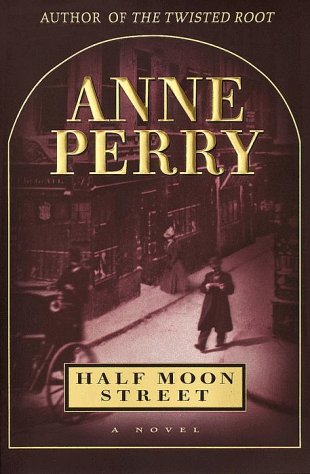
Half Moon Street - Anne Perry

As a murder mystery, this is an odd one. While there is a murder to be solved, and the themes of the novel add to our understanding of the case, this is really more of a period drama with added murder-mystery.

A body is found shackled to a dingy on the Thames, a man dressed in a woman's gown and strewn with flowers in the style of Ophelia. Superintendent Thomas Pitt tries to discover the dead man's identity, and finds himself thrust into the theatrical world of actors and photographers.

What feels like the main focus of the novel, however, is the marital relationships of three couples: first, Pitt and his wife Charlotte, currently on holiday in Paris, who he misses greatly and thinks of with tenderness. Charlotte's mother, Caroline, who remarried after the death of her first husband to an actor 17 years her junior, feels insecure about the age difference and worries she may be too old-fashioned for him. Her widowed mother-in-law, Mariah Ellison, who is staying with them, is still haunted by memories of her abusive husband.

The lives of these three very different couples, linked into one extended family, intertwine and affect each other in subtle and moving ways. There is a lot of consideration given to concealment and censorship, both with regards to artistic creation and to personal relationships.

It really is the social dramas within this novel that stayed with me, rather than the murder, which is thrust onto the sidelines a bit. I feel as though the blurb would be better off mentioning this rather than presenting it as a traditional detective novel, but all the same I enjoyed it – it gives a very compassionate view of the challenges of living honestly in a society bound by strict social convention.


Next up: Bitterblue by Kristin Cashore

Sunday, 10 August 2014

Graceling - Kristin Cashore


Graceling came with the rather dubious recommendation, “[This] exquisitely drawn romance … will slake the thirst of Twilight fans”, on the front cover. However, I really enjoyed Fire, so I went ahead and read it anyway.

While it doesn’t quite have the accomplished sense of depth of Fire, this is Cashore’s debut novel, and as such that’s simply a sign that her novels have developed since the beginning. She does a good job of introducing us to the fantasy world the story takes place in, without being artificially explanatory or giving us too many made-up terms to try and remember.

The heroine, Katsa, is a graceling, marked out by her mismatched eyes and an uncanny natural ability – in her case, the ability to inflict violence. Ever since her gift was discovered, her uncle the King has been using her as a tool of intimidation against those who displeased him. A chance to investigate the mysterious kidnapping of a neighbouring King's father offers her an opportunity to escape and to prove to herself and others that she’s more than just a mindless thug.

One of the things that really stood out about this novel was the unusual angles we see events from. Katsa is an unconventional young woman, but this is only to be expected as the heroine of a young adult fantasy novel. However, the feel of the narrative is also different – while the novel appears to be of the standard ‘vanquish the villain’ type, you get the feeling that defeating the bad guy wasn’t really what it was all about.

The Twilight-style epic romance promised on the cover was, thankfully, more human and believable than that, albeit made more complex by the respective graceling abilities of the pair involved. This novel is populated by strong characters throughout, and we also meet Princess Bitterblue, the protagonist of the third and final novel in the trilogy. Despite being a child, she's forthright and intriguing, and I’m really looking forward to reading more about her.


Next up: The Unquiet Bones by Mel Starr

Sunday, 27 April 2014

Fire - Kirsten Cashore


The first thing I have to say is that this book deserves a better cover. The Gollancz version (the one I read) is your typical teen-fantasty ‘girl-with-weapon-standing-on-rock-with-mystic-looking-background’ image. And the part that grates with me most is the fact that, if the image is actually trying to reference any part of the book, the dress should be purple, not red. 

The Dial YA version of the cover is better, featuring a bow and arrows rather than lady-in-dress, and I really like the understated originality of the Clarsen YA German edition.
 

Inside, Fire is anything but your average YA fantasy novel. The usual elements are there – insular non-time-specific low-tech kingdoms, magical powers, and so on – but Cashore takes it so much further. The protagonist, Fire, has a complexity to her sexual past which is refreshing compared to the coyness YA novels often have about sex. It helps the reader to see her as a rounded human being, rather than a copy-and-pasted heroine. The intricacy of the relationships between all of the characters in this novel is really well done, and leads to some truly surprising and touching moments.

Naturally, Fire does have special powers – what self-respecting fantasy heroine doesn’t? She was born a ‘monster’, a genetic aberration possible in any species, which gives the individual very bright colouring and unnatural beauty, and the power to influence the minds of those around them. Making your heroine inhumanly beautiful is a tricky thing to pull off without making it all feel like a giant piece of wish-fulfillment, but Cashore manages it. Fire sees her appearance as a disadvantage in most situations, and never truly comes to accept it as an integral part of who she is, not even by the end. Cashore also considers the logistics of Fire’s condition; ‘monsters’ are cannibalistic and lust after each other’s blood, which means that she is constantly attracting ‘monster’ insects and that she can’t leave the house when on her period without being mobbed by raptors.

Another aspect I really liked about this novels is that Fire isn’t the be-all-and-end-all of everything. Of course, as the protagonist, she does lie at the centre of the story, but she is only involved in a very small part of the events taking place. The fact that she recognises her insignificance amid grand political schemes and the war sweeping the kingdom adds a sense of perspective not often found in fantasy novels.

Overall, I really enjoyed this one, and am looking forward to reading the other two in the trilogy, Graceling and Bitterblue.

Next up: Cousin Kate, by Georgette Heyer