Showing posts with label G K Chesterton. Show all posts

Tuesday, 15 September 2015

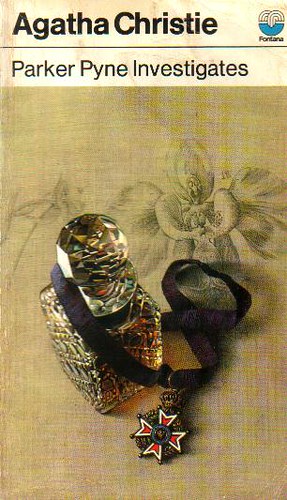
Parker Pyne Investigates - Agatha Christie

Parker Pyne Investigates is more a series of short stories than one novel, featuring Mr Parker Pyne, an ex-statistican who now consults for a living. He claims not to be a detective, and in fact he's almost the opposite of a detective – people come to him unhappy from insecurity in their marriage, dissatisfaction with their lifestyle, or simply out of boredom – and he secretly engineers events which push them in the direction of becoming happier.

The first half of the book has a collection of these 'consultation' stories in London, but the second half follows Mr Parker Pyne on a series of travels around the Middle East, Egypt and Greece, in which he finds himself reluctantly pulled into playing the detective even on holiday.

As a character Parker Pyne feels like a cross between Poirot and G K Chesterton's Father Brown. His apparently haphazard methods and understanding, stolid manner almost always lead to him succeeding somehow, and he takes success or the occasional failure with the same amiable placidity.

This collection of short stories feels almost like an artist's sketchbook, where an idea or concept for one of Christie's more complex plots is briefly sketched out and played with to explore its potential. The stories are amusing, ironic and full of trademark twists and good-humoured melodrama.

Overall, a light, pleasant read for any mystery fan.


Next up: Bridget Jones' Diary by Helen Fielding

Friday, 28 March 2014

The Complete Father Brown Stories - G K Chesterton

I can't believe it's actually taken me a month to finish this book, although in my defence I did work a lot, and it is a very long book. Each story varies between about 10-20 pages, but the complete collection weighs in at almost 800 pages.

I'm not normally a fan of short stories (the only collection I've really enjoyed is Michael Marshall Smith's What You Make It). My reason for disliking most is that they lack a sense of depth and continuity, the ability to get lost in them, which is my main motivation for reading fiction in general. The Father Brown Stories, however, obviously have continuity, because they're a set of stories about the same character. Each mini-mystery manages to set the scene so effectively that, even after 15 pages, you feel as though you've lived a full novel in the setting.

G K Chesterton also has a gift for pithy and amusing character description - a good example is:

He saw Dr Simon, a typical French scientist, with glasses, a pointed brown beard, and a forehead barred with those parallel wrinkles which are the penalty of superciliousness, since they come through constantly elevating the eyebrows. (from 'The Secret Garden')

His ability to effectively describe a character or place in one sentence in a way that really evokes them is what, for me, really sets these stories apart. The mysteries themselves vary in their complexity and convincingness, but are always solved with a wonderful sense of humanity and compassion. Most other detectives I remember reading about see the crime as a cold, set puzzle to be solved analytically and the criminal mercilessly packed off to gaol, if they haven't already been killed in some way. Father Brown, however, solves a crime by imagining the type of person who would do such a thing, putting himself in their place, and working from there. When he's discovered the criminal, he often lets them escape rather than dragging them in to face the full force of the law. He even converts a world-reknowned thief to the side of justice and remains fast friends with him throughout the series.

I wouldn't necessarily recommend reading the entire set of stories back-to-back (unfortunately I feel compelled to read books that way, but I'm not sure it's the way to get the best out of short story collections), but I'd definitely recommend them as something to dip into. Each story is atmospheric and the pervading sense of compassion gives a much more optimistic feel that that found in most detective stories.

Next up: The Eyre Affair, by Jasper Fforde

Friday, 21 March 2014

Divergent - Veronica Roth


Surprise review!

I know I said the next review would be of The Complete Father Brown Stories, but frankly, at over 800 densely packed pages, it’s very long. I thought I’d intersperse some light relief in the form of Divergent, the first novel in Veronica Roth’s teen trilogy.

I hadn’t heard of this novel until I saw a trailer for its film adaptation in the cinema, and had been looking out for it since. I thought the trailer looked interesting, but a little like it was jumping on the Hunger Games bandwagon.

Divergent did remind me of The Hunger Games, but mostly in a positive sense, in that it’s a teen dystopia with a strong female protagonist. The setting is a society divided into five distinct, sequestered factions, based on primary personality traits – Abegnation for the selfless, Dauntless for the brave, Candor for the honest, Erudite for the intelligent, and Amity for the peace-loving. On reaching 16 each child undergoes a test to determine their most suited faction. While most get a distinct recommendation, Beatrice’s results are inconclusive, making her a Divergent, someone who doesn’t fit neatly into any one of the factions. She chooses to leave her family and join the Dauntless faction, and the novel follows her struggles to adapt in her new life, in a world about to fall apart.

I thought the obligatory teenage romance aspect was rather more simplistic than that in The Hunger Games, but then again I really liked the more complicated and gender-stereotype-reversing romantic situation between Peeta and Katniss, so Divergent had a lot to live up to there. In terms of grittiness, this novel got its collateral damage in almost from the beginning, and the sense that  there are real consequences to the characters’ actions is with you throughout.

I felt as though I could see the larger of the plot twists coming, but was pleasantly surprised to be surprised by some of the reveals that took place. I can confidently say that, if you enjoyed The Hunger Games, you’ll like this, and I look forward to reading the other two novels in the trilogy and to seeing what they make of the film adaptation.

Next up: The Complete Father Brown Stories, by G K Chesterton

Wednesday, 26 February 2014

The Time Traveller's Wife - Audrey Niffenegger


You know that sensation when it’s hard to think clearly about a novel because you still feel lost in the world it creates? That's how The Time Traveller’s Wife has me feeling right now. I have to admit that it’s because of the film adaptation that I read it – I would probably never have considered it if I hadn’t seen it plastered all over buses a couple of years ago. The film looked interesting, and I always like to read the book before I see a film adaptation, so I’ve been looking out for it since.

The Time Traveller’s Wife focuses on the relationship between Clare and Henry, as he struggles with his unusual condition of epilepsy-like time travel. That is to say, at any moment, particularly during times of stress, he may have a fit of sorts, disappear, and reappear in an unpredictable time period and location.

Niffenegger deftly avoids creepy Humbert Humbert-like insinuations as Clare grows from a child to a young adult with Henry as her frequent visitor, coming from different periods of time in his own life. When they meet in real time, their life together is sometimes happy, sometimes challenging, and occasionally heartrendingly painful, but always believable and carries a sense of immediacy that has you feeling as though you know the characters in real life.

I sometimes find novels written in the present tense harder to get on with, but I think in this instance it really works – where time travel is concerned, the present tense really brings home the fact that this is happening, here and now, in the present. While at first it feels a little slow, it gathers momentum as it progresses, and you find yourself drawn in by the weight of inevitability as the story draws to a close and all the pieces come together.

I’m still not sure which genre it falls into – usually anything involving time travel can be comfortably classed as ‘science fiction’, but Niffenegger takes the idea and creates something wonderfully human and compelling. The Observer’s description on the cover, of The Time Traveller’s Wife as “an old-fashioned love story” made me a little dubious at first, but it’s true, in the best sense – there’s no clichéd sentimentality to be found, only two people struggling to come together and live a happy life in spite of all their obstacles.

I can’t compare it with the film because I haven’t watched that (yet – I plan to redress this shortly), but I will say that, if you did enjoy the film, read the book! And if you haven’t seen the film either, read the book anyway.

UPDATE: I have now watched the film!

Next up: The Complete Father Brown Stories, by G K Chesterton