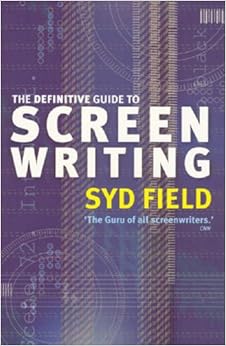
I began this book completely uneducated
as to screenwriting – I'd watched and enjoyed films, but had no
idea what went into the process of crafting them. Field starts out by
explaining the basics of film structure and theory (very useful if,
like me, you're a total beginner), then goes on to dedicate
individual chapters to specifics like character, plot, and each
section of the film. He finishes by explaining the process of turning
a freshly-written screenplay into an eventual film, which again was
very useful new information for me.
Field has an open, conversational style
that makes for approachable reading and ease of understanding. I did
find that some points felt rather laboured, and that he takes a
rather didactic tone (sometimes it felt like I was being told what to
think and feel, as well as what to do, during the screenwriting
process), but on the whole this was very engaging and pleasant to
read considering it is, essentially, a textbook.
As my own background is in literature, it
was especially interesting for me to see the very different methods
by which a screenplay must tell a story – by showing only the
external, in particular tiny details that would be implicit in a
novel – as opposed to the forms I'm more used to, where the reader
is usually privy to what goes on in the protagonist's head, and any
external cues we're given are those perceived specifically by that
character.
I couldn't help but feel a bit annoyed
by Field's assertion that for a film adaptation of a novel “you are
not obligated to remain true to the original material.” I can see
that there are great challenges involved in transferring a story from
one medium to another (more than I'd appreciated before reading this
book), but I, and probably many others, are familiar with that sense
of disappointment that comes when you see a much-anticipated screen
adaptation of a beloved novel and it just isn't the same, it doesn't
capture what you loved about the book at all. In my opinion there's
nothing wrong with a screenwriter reading a novel and feeling
inspired to write a screenplay on a similar theme – just please,
please, unless you're willing to be faithful to the original, don't
label it as an adaptation.
Next up: Powder and Patch by
Georgette Heyer