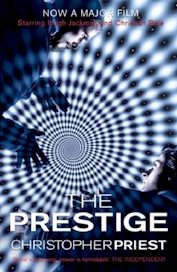
Having seen
the film adaptation of
The Prestige
some years ago, I thought I knew what to expect from the book. I soon found
out, however, that it was a rather loosely based adaptation, with the main
characters and premise transplanted into an almost entirely different plot. Not
that it wasn’t good – I remember enjoying it and being surprised by the ending,
even if I had a lot of difficulty telling Hugh Jackman and Christian Bale
apart.
Perhaps
unsurprisingly, I have to say that I prefer the book – as with most film
adaptations, a lot of depth was lost in translation to the screen. The novel is
narrated by four different characters – two Victorian illusionists, and their
modern-day descendants. With each retelling of events, we learn more about what
occurred, and the differences in perspective between characters are clearly
shown. The reader can also get a better insight into each character
individually, as we read their views (in the form of dairies or notes, in the case
of the illusionists), and it is interesting to see the parallels between the
two men who make themselves sworn enemies.
It’s
explicitly stated in the novel that Borden and Angier’s feud really is petty,
and that both regret it at some point. For me, this adds a poignancy to the
fact that they helped to ruin each others’ lives for no major purpose. The
repercussions of the illusionists’ actions on their descendants 100 years later
also frames the narrative in a way that (if I remember rightly) is lacking in
the film.
The results
of operating the device Angier has Tesla create for his magic trick are less
melodramatic than in the film, but more spine-chilling for all that. Priest
creates a hint of the unnatural as well as the scientific, evoking almost an H
G Wells-like feel by the end as the full repercussions of Angier’s use of the
machine are felt.
As I
expected events to pan out the way they did in the film adaptation, parts of
the novel were a genuine surprise to me. I realised after finishing that, as
with any good magic trick, I hadn’t been given enough information to fully explain
events, but that, in the midst of the action, I hadn’t even noticed.
Well worth
reading if you’re a fan of the film, or even if you’re not. And if you enjoyed
reading this, watch the film! It’s different enough that it’ll still
surprise you.
Next up: Rumpole à la Carte, by John Mortimer
 This was my
first foray into the Rumpole series, but I found that, apart from the
occasional (footnoted) reference to the events of previous stories, it didn’t
really spoil my enjoyment. Characters are introduced succinctly but enough that
you get the gist of their personality, even if they’re new to you.
This was my
first foray into the Rumpole series, but I found that, apart from the
occasional (footnoted) reference to the events of previous stories, it didn’t
really spoil my enjoyment. Characters are introduced succinctly but enough that
you get the gist of their personality, even if they’re new to you.