Showing posts with label Nymphomation. Show all posts

Thursday, 18 February 2016

Automated Alice - Jeff Noon

Automated Alice is essentially Alice's Adventures in Wonderland in a cyberpunk universe. A little Victorian girl named Alice is bored with her humdrum existence, and is transported through a grandfather clock to the future, or at least to 1998, which was the future in 1996 when the novel was published. Once there she meets her Twin Twister, a life-size embodiment of her favourite doll Celia, who has been animated by an inventor and joins Alice on her quest to get home.

Alice is under suspicion for the famous Jigsaw Murders, in which the victims are found dismembered and stitched together in a nonsensical fashion. They are found with one jigsaw piece each, all of which are missing from Alice's jigsaw puzzle in the past. She and Celia decide that the only way to get home is to retrieve all of the missing puzzle pieces, while evading the clutches of the police.

In many ways Automated Alice feels like it ought to be a children's book – it's told in a matter-of-fact, childlike voice and even has wonderfully quirky full-page illustrations, as well as smaller doodles throughout. There are aspects, however, like the practical but detailed way in which the murder victims are described, that would be very much out of place in a children's book. Noon keeps the dreamlike feel of Carroll's original and applies it to his own, more modern universe found in Vurt and Pollen (and later Nymphomation) to create a very readable, but very unsettling, atmosphere.

The novel questions the boundaries of fantasy and reality in a way I'm sure Carroll would have approved of. Alice meets an authorial figure, Zenith O'Clock, who has a very existential conversation with her questioning whether she represents the Alice known in real life by Carroll, the Alice in the book he wrote, or another Alice entirely. A cameo appearance by Lewis Carroll himself increases the blurring of lines.

For those who have read Noon's other novels, Automated Alice offers some interesting theories about the background to the culture he's created which set Vurt, Pollen and Nymphomation in a different light.


Next up: The Masqueraders by Georgette Heyer

Saturday, 9 January 2016

2015 Greatest Hits

Booking Through Thursday's New Year question (late again, I know) is:

What were your favorite books of 2015?
How many books did you read this year? Are you happy with the amount of reading you got done? Wish you’d had more time? (I know I always do!)


In 2015 I read 32 books, if you count those overlapping year boundaries. I do wish I'd read more, I always do.

In terms of favourites, I'll pick out some in chronological order:

A Corpse at St Andrew's Chapel by Mel Starr (read 12/02/2015-21/02/2015)
The Chronicles of Thomas Covenant, the Unbeliever by Stephen Donaldson (read 03/04/2015-10/05/2015)
Les Liaisons Dangerueses by Pierre Choderlos de Laclos (read 20/06/2015-15/08/2015)
Thank You, Jeeves by P G Wodehouse (read 10/10/2015-11/10/2015)
Nymphomation by Jeff Noon (read 12/10/2015-17/10/2015)

May 2016 bring some equally good reading!

Thursday, 22 October 2015

Nymphomation - Jeff Noon

Nymphomation is Jeff Noon's fourth novel, and acts as a prequel to Vurt and then Pollen.

Set in 1999 Manchester, it offers a futuristic alternative view of a familiar unglamorous city, in which a trial lottery game called Domino Bones is being held. Along with the weekly domino draws, in which only one person can win the grand prize, AnnoDomino have created flying advertisements which buzz around the city, interbreeding and multiplying. As the city's obsession with with Domino Bones grows, a group of rogue mathematicians suspect that the game is not what it seems and try to break into the system.

Noon tells the story in quick scenes, sometimes no more than snapshots, that tell us almost enough but never too much, and keep you reading as you try to discover more. The characters and setting are drawn briefly but effectively, often using random-seeming and exaggerated language that lends the novel a lurid, unreal quality. Mathematics and the science of chance are blurred with fantasy to form an intriguing universe in which anything is possible.

This novel is a very human experience of something inhuman, while also managing to be extremely thought-provoking and at times sinister and unnerving. At first I didn't realise it linked up to the other books in the series, and by the end it had set the scene for the development into Vurt and made me want to reread that with fresh eyes again.

There's only one I haven't yet read in the series, Automated Alice, and I'll definitely be asking for that for Christmas.


Next up: The Rose Rent by Ellis Peters

Saturday, 17 October 2015

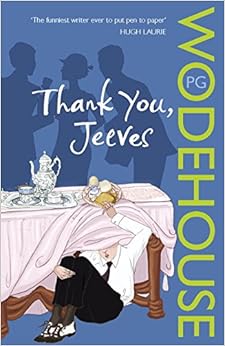
Thank You, Jeeves - PG Wodehouse

This is the first of Wodehouse's novels to feature the wonderful Jeeves, and the first that I've read, although I have watched the Jeeves and Wooster TV series many many times. Usually I'd say that watching an adaptation before reading the book spoiled it for me a little, but Steven Fry, Hugh Laurie and the mood of the production as a whole captured the feel of the characters and the story so perfectly that I didn't mind seeing them play it out in my head as I read.

Bertie Wooster's new musical instrument, the banjolele, drives him by popular complaint from his London flat to a country cottage on his friend Chuffy's seaside estate, and also forces Jeeves to give notice, who is promptly rehired by Chuffy himself. Bertie's peaceful country retirement is shattered by the arrival of his beautiful, charming and unregretted American ex-fiancée Pauline Stoker and her disapproving father, and an amusing sequence of evasions, misunderstandings and reconciliations follows.

Bertie's amiable but vaguely bemused viewpoint gives humour to every scene, for instance one in which he and Pauline are (through a completely innocent if highly unfeasible set of circumstances) about to be discovered alone together in his bedroom, she wearing his pyjamas, begin to argue about the niceties of grammar rather than the problem at hand.

Some of the events in the novel were moved around or taken out to shorten it a little for the adaptation, so even having seen the episode I wasn't sure what was going to happen next. Unusually, I don't feel as though the changes necessarily made the story worse, or better for that matter – it was just a case of reaching the same conclusion through slightly fewer stages. There were a few very funny scenes which sadly weren't kept in, though. One confusing factor, given that this is the first Jeeves novel written, was the casual references to other characters and amusing anecdotes that I'd already seen in the TV series but obviously hadn't in the books.

I laughed frequently throughout the novel, and sometimes worried about waking people up in the next room when I was reading in bed. Having read this I'm definitely going to look out for the rest of the series.


Next up: Nymphomation by Jeff Noon