Showing posts with label E M Delafield. Show all posts

Tuesday, 9 September 2014

The Diary of a Provincial Lady - E M Delafield


If Bridget Jones had been a 1920s housewife, this would be her. The fictional diaries of the unnamed Provincial Lady document the daily life of the well-intentioned, self-conscious and scathingly sarcastic narrator. We are shown her family life in a small village in Devon, and in the sequels follow her on a tour of America and to London during WWII.

While not very much “happens”, as such, the wonderful turns of phrase and the diarist’s acerbic observations on human nature had me sniggering rather loudly in the canteen at work. My boyfriend picked it up at one point, glanced down the page and asked me when it was written. When I told him the 1930s, he said that he hadn’t realised people were so sarcastic in those days.

The Diary of a Provincial Lady defies the common preconception that older books tend to be quite polite and sedate, and instead looks with a keen sense of the ridiculous at peoples’ everyday habits and tendencies. A cleverly written series of books that have the feel of sitting down for a cup of tea and a gossip with an old friend - perfect for curling up with at the end of a long day.


Next up: The Girl Who Played with Fire by Stieg Larsson

Saturday, 16 August 2014

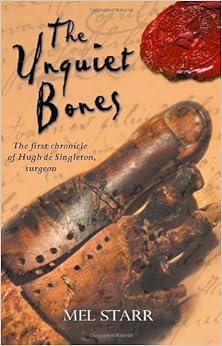
The Unquiet Bones - Melvin R Starr


I was struck from the very beginning of this novel by the style of the prose. The story is framed as an account in the first person by Hugh de Singleton, a young surgeon investigating the murder of a girl found in the cesspit of his patron’s castle. The language is uncomplicated with no aspirations to poetic beauty, but instead has a wonderful clarity to it. The narrator’s candid honesty and independent mind made this a joy to read, and gave me the feeling that if Hugh de Singleton were a real person, he’d be someone I’d very much like to know.

Another advantage Starr’s novel has over most historical stories is that the narrator is, himself, imbued with medieval values. Too often, authors simply place a character with modern attitudes in an historical setting, with no real consideration for how they could possibly have developed in a way so different to everyone else at the time. Of course, for the reader to relate to the protagonist we must have points in common – and in The Unquiet Bones Hugh is very much a progressive, but in a way that could have been possible at the time. While he favours contemporaneous modern medical theories, and believes in bathing even in winter, he still takes the social status quo for granted and respects its boundaries.

As usual when historians turn to writing fiction, this novel is full of great little details that add to the atmosphere and to the genuine feel of the time. Everything from the seating and food at dinner to some rather graphic surgical descriptions and a thorough understanding of the different clothing styles allowed to various social classes is included. These facts aren’t thrust in the face of the reader, however, but taken for granted by the narrator as common knowledge.

The central mystery itself is well thought out and takes several twists and turns before reaching its conclusion, and we get to know several ancillary characters as the story progresses, which makes a nice change from most murder mysteries, in which the characters encountered are often just there as parts of the puzzle.

This one was a very pleasant surprise, and I’m happy to discover that there are 6 more left in the series.


Next up: The Diary of a Provincial Lady by E M Delafield

Monday, 3 March 2014

Book Haul: Episode II

I know, I really shouldn't have. But with paperbacks 50p each and hardbacks £1 at a local charity shop, I think it's a testament to my amazing self-restraint (and the fact that most of the selection available were romances or thrillers) that I came home with only 6 books.

Today's additions to my not-so-little family of books are Alice Sebold's The Lovely Bones, Christopher Priest's The Prestige, Jasper Fforde's The Eyre Affair, E M Delafield's The Diary of a Provincial Lady, Edward Marston's The Iron Horse, and Stephen Fry in America.

The first two I chose because I'm aware of the films (I've seen and enjoyed the film of The Prestige, but haven't seen The Lovely Bones yet), and I've read another Jasper Fford and loved it. I've heard good things about The Diary of a Provincial Lady, and other two just looked fun. Now to squeeze a little more space out of my bookshelves...