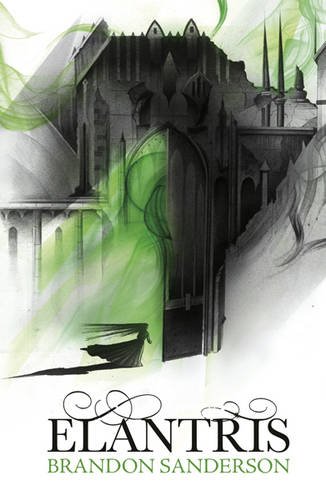
 As I’ve
mentioned before, I’m a big fan of Brandon Sanderson, so I’ve been really
looking forward to reading his debut novel, Elantris. The friend who lent me this novel said he’d thought the
language and plot were rather clumsy compared to his later novels, but I have
to say I mostly disagree. Admittedly, Elantris
has the odd moment where the words chosen or the sentence structure doesn’t
feel quite right, but on the whole it’s still really well written. It’s true
that Sanderson’s writing becomes more polished as his career progresses, but
there is nothing amateurish about this novel.
As I’ve
mentioned before, I’m a big fan of Brandon Sanderson, so I’ve been really
looking forward to reading his debut novel, Elantris. The friend who lent me this novel said he’d thought the
language and plot were rather clumsy compared to his later novels, but I have
to say I mostly disagree. Admittedly, Elantris
has the odd moment where the words chosen or the sentence structure doesn’t
feel quite right, but on the whole it’s still really well written. It’s true
that Sanderson’s writing becomes more polished as his career progresses, but
there is nothing amateurish about this novel.
The titular
city was once the glorious home of god-like inhabitants, whose pale skin and
white hair shone like silver, and who could perform magic to raise seamless
palaces, heal wounds, and create food out of dust. One day, however, the magic
suddenly failed, the Elantrians’ hair fell out, and their skin
became grey and blotchy. As their magical powers faded away, they were locked
in the city to rot, leaving the outside world in the grip of civil war.
The plot
begins 10 years after the fall of Elantris, when a foreign princess is brought
to the neighbouring city of Kae in a political marriage to unite two kingdoms against an aggressive
religious expansion. When she arrives, however, her husband has been declared
dead – but in fact has become an Elantrian and been incarcerated in the
crumbling city. We follow her efforts to avert civil war, and her husband
Prince Raoden’s struggle to survive in his half-life in the dilapidated
ruins of Elantris.
As in his
later novels, Sanderson treats magic more like a science. It has strict rules
and limitations, more like a kind of script-based alchemy than the type of
magic used by your average fantasy wizard. He even includes a glossary of
symbols at the back. In a nice added touch, each chapter is headed with a
symbol indicative of the themes it contains.
Coming to
this novel after having read many of his other works, the Mistborn series and Warbreaker
in particular (both of which I highly recommend), Elantris feels rather like a testing ground for many of the ideas
explored more fully in his later books. It still works perfectly well as a
cohesive story, but it does have a cut-down sense to it, leaving me feeling as
though I’d like to have more detail on some of the concepts and characters in
it. There are echoes of the relationship dynamics and magical systems that form
the core of the Mistborn novels, and
the enclosed city populated by ‘gods’ is strikingly similar to the basis for Warbreaker.
Elantris is a compelling, intriguing
novel that grips you from start to finish, and as a debut novel is even more
impressive. If you’re a Sanderson fan but haven’t got round to reading this one
yet, do so immediately! And if you’re into any kind of fantasy novels, you’ll
enjoy this, I promise.
Next up: Murder on the Orient Express by Agatha
Christie

