Showing posts with label Brent Weeks. Show all posts

Thursday, 3 July 2014

Shadows Edge - Brent Weeks


After The Way of Shadows, I had high hopes for this novel, and I wasn’t disappointed. Weeks builds on the first installment, weaving events and characters deftly together in a way that, for the most part, is subtle enough to go unnoticed, but all culminates at the end. There were a few points at which a character does something without thinking and I thought “This seems important”, but I had no idea why it would be important, so if anything that increased the sense of anticipation.

We begin with Kylar, the main character, attempting to renounce his career as an assassin and settle down with his childhood sweetheart Elene and their adopted daughter, Uly. However, events pull him inexorably back to his invaded hometown, and he is forced to accept the fact that he is meant for greater things than living quietly as an apothecary in a foreign country.

This novel introduces some new point of view characters, and also gives us some surprising changes of loyalty for characters from the first novel. One of the most outstanding things about The Night Angel Trilogy for me is the moral complexity it creates – both good and bad characters do things that could be construed as either good or evil, and Weeks rejects the idea that anyone can be all unadulterated good or evil. A particularly poignant example is the close friendships the rightful king Logan makes in the dungeon with some of the murderers, cannibals and prostitutes, who are still human beings despite their pasts and their horrific surroundings.

There are many point of view characters, and I did occasionally find it hard to remember exactly who they all were and who was allied with whom, but everything inexorably led to the climax of the novel, where it all came together with a momentum that just makes you keep reading.

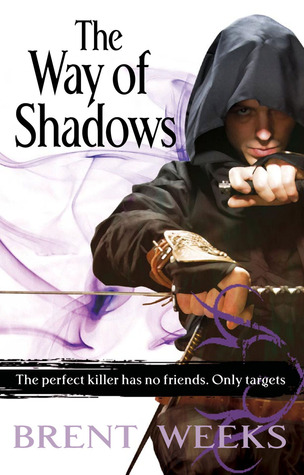
One minor gripe I have with the trilogy is the artwork on the covers. I know it’s a minor thing, but it is easy to look at the cover of a book and decide then and there whether you want to buy and read it. I get the impression that they were aiming for a similar effect to the style of Brandon Sanderson’s novels – a plain white background, with a figure and abstract colour swirls. What makes Sanderson’s covers beautiful, however, is the artwork, whereas for Weeks’ trilogy we have a slightly blurred
photoshoot with some guy in a black costume. Because it’s a photograph rather than artwork it just looks strange with the overlayed swirl of colour. The complete trilogy has a black cover with a simple sword across it, which to my taste is much more effective.

Anyway, the cover makes no difference to the contents – I just feel that with such a great story inside, this trilogy deserves better presentation outside. It’s definitely well worth reading, and I’m looking forward to seeing where the third book leads.


Next up: An Excellent Mystery by Ellis Peters

Thursday, 12 June 2014

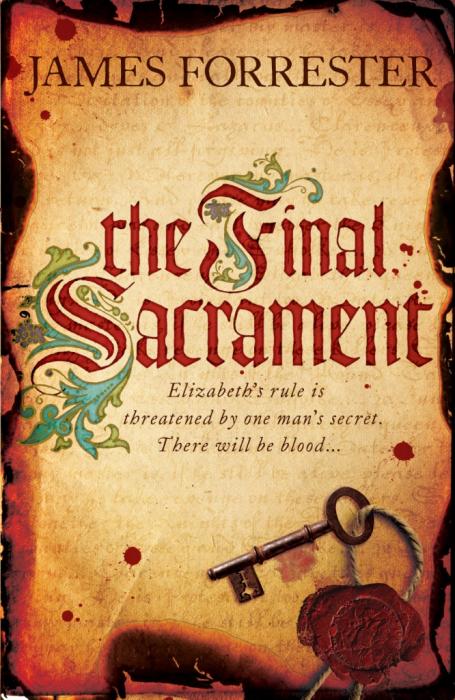
The Final Sacrament – James Forrester/Ian Mortimer


I know it’s taken a while to get through this one – for one thing, I started a new job, which means that I have more free time, but also that I’m actually doing stuff with my free time now, rather than reading on my own in a windowless office. Also, this book was a little difficult to get through.

It’s not a bad novel as such, I just found it hard to warm up to any of the characters, especially Clarenceux, the protagonist. They all feel a little two-dimensional, more like archetypes than rounded characters. It doesn’t help that Clarenceux spends the majority of the novel worrying, which is understandable, as he is trying to hide a pivotal document from important and powerful people while keeping himself and his family safe. However, it means that a mostly negative and slightly stressful feeling pervades the narrative – for me, the novel has too much grief and not enough in the way of happiness to make it really enjoyable.

Another issue in reading this was the strange way the viewpoint switches between characters. While it's told in the third person omniscient style, it’s more usual to either change viewpoints strictly between sections (à la George R R Martin) or to be a totally unbiased narrator, knowing everyone and everything (George Eliot, for instance). Mortimer, however, casually switches viewpoints within the space of a couple of sentences, and then returns to the original characters’ consciousness, which I found vaguely unsettling, rather like an out-of-body experience.

The back cover informs me that James Forrester is the pen name of historian Ian Mortimer, so I went into this one expecting a lot of historical detail. I wasn’t disappointed – this was where the novel really stood out for me. Mortimer’s intimate knowledge of Elizabethan life shines through in Clarenceux’s pride in his new glass windows, in the detailed description of a woman washing clothes, or in the food eaten at a Christmas feast. Where many novels would gloss over little details, we can really picture the minutiae of each scene, which not only adds very much to the atmosphere but also taught me new things about life at the time.

The downside of this is that Mortimer seems to expect his audience to be just as knowledgeable as he is on the subject of Elizabethan politics. The reader is thrown in at the deep end with a discussion between Queen Elizabeth, Francis Walsingham and William Cecil, with very little explanation of the background or motivations for each character. I am interested in history, but not to the extent that I feel so familiar enough with figures like Walsingham and Cecil that I don’t need an introduction to them, as you would with fictional characters.

That said, the momentum grew throughout the novel, and I found the ending genuinely touching. While some aspects of the prose lack finesse, The Last Sacrament is a well-researched and atmospheric novel, which left me feeling that I’d learned something at the end of it.


Next up: Shadow’s Edge, by Brent Weeks

Saturday, 3 May 2014

The Way of Shadows - Brent Weeks


This was one of those books you really can’t put down, and keep thinking about even once you’re finished.

Azoth is a young boy trying to survive in the brutal world of the slum guilds, who dreams of becoming a wetboy (assassin aided by innate magical ability) like the legendary and fearless Durzo Blint. He manages to get taken on as Blint’s apprentice, and grows up in a world of intrigue, suspicion and plotting in his new identity as Kylar Stern, dispossessed nobleman. We see Kylar/Azoth’s progression from vulnerable urchin to professional killer, and his struggles to keep those he loves safe in a dangerous world.

The only negative thing I could say about The Way of Shadows is that sometimes the wide range of cultures that meet in the novel result in so many different cultures, titles, regions, and legends coming together that it becomes difficult (or did for me) to remember all of them. That said, the rich and diverse background to the novel really does give a sense of the metropolis in which the novel is set. It’s quite possible the reason I had difficulty remembering things was because I did most of the reading on night shifts, where I was sleepy and frequently interrupted by the need to do work.

There is a wonderful intricacy in the way in which many different characters’ stories intertwine, and in the way the consequences of someone’s actions change the course of another character’s life. While the focus is on the protagonist, parts of the prose are written from other points of view, which adds to the sense of an interweaving pattern.

Throughout the novel the action is fast-paced and compelling, if vivid and gruesome at times. Plot twists and surprised leap out frequently, not just at the end, and the reader is drawn in, wanting to discover more. There’s an ambiguity to it that feels very human, rather than attempting to justify Kylar’s choice of career on a moral level to make him likeable as a character. It isn’t just a story about a boy becoming an assassin, it’s a story about hatred, love, cruelty, betrayal, and redemption, and it’s well worth reading.

Next up: The Prestige, by Christopher Priest

Monday, 28 April 2014

Cousin Kate - Georgette Heyer


This is an odd one, because it’s historical fiction, written almost 50 years ago. Part of me thought that it might closely resemble modern historical fiction, but that part of me was wrong.

Nowadays historical fiction often tries to focus on realism, on capturing the mindset and atmosphere of the people living at the time. Heyer, however, simply transplants a plucky 60s young woman into the nineteenth century, making her an unfeasibly attractive and outspoken penniless governess. Kate is invited to stay with her rich aunt Lady Broome and her admittedly odd cousin, Torquil, and discovers various dark family secrets along the way.

Virtually every character in this novel speaks in a bizarre kind of slang, which I initially assumed was common 60s slang, but The Sunday Times claims that it is “slang beautifully rendered” – presumably regency slang, or the contemporaneous idea of it. Having lived through neither the regency period nor the 1960s, I can’t say for sure, but it feels a bit jarring to me.

That said, it’s an amusingly melodramatic romance, and a fun light read.

Next up: The Way of Shadows, by Brent Weeks

Wednesday, 23 April 2014

Book haul

I accidentally went charity-shop book-shopping again today...  Got a good selection of fantasy and historical novels this time, namely: all three of The Night Angel Trilogy by Brent Weeks, The Final Sacrament by James Forrester, The Historian by Elizabeth Kostova, The Last Days of Newgate by Andrew Pepper, and The Coma by Alex Garland. That last one doesn't fall under fantasy or historical, but I studied his first novel The Beach during my degree, and really enjoyed it.

Now to find space on one of my bookshelves! Ha...