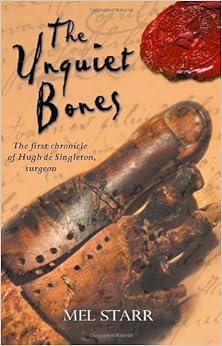
I've been looking forward to this one ever since reading the first novel in this series, The Unquiet Bones, and I wasn't disappointed by the sequel.
Hugh de Singleton is a candid but openly flawed narrator, admitting when he takes credit for things he shouldn't or deceives by omission. He has no pretensions of being a hero, or even of being a particularly good bailiff, but sets out to do his duty as well as he can. As in the first novel, he does have progressive views on things - religion in particular, in this book - but his mindset is definitely more medieval than modern.
The beadle of the manor is found apparently mauled by a wild animal, but missing his shoes. When those shoes appear on the feet of one of the villagers, questions need to be asked that lead to much more than a simple wolf attack.
There are some wonderful historical details, for instance belches being a polite way to flatter your host by complimenting their dinner, and Hugh (like me!) takes pleasure in his meals, listing the dishes eaten and the manner in which they were served.
The mystery itself meanders through several different possibilities before finally discovering the truth. Hugh approaches his investigations in a Poirot-like manner, gathering most of his evidence from his knowledge of human beings and not from cold analysis.
A fascinating and immersive sequel from Mel Starr - the only bad thing is that this story ends on a cliffhanger leading into the next novel, and I don't have it so I can't read it right away!
Next up: The Adventures of Sally by P G Wodehouse
Showing posts with label The Unquiet Bones. Show all posts
Sunday, 22 February 2015
Thursday, 11 September 2014
Recommendations
This week's Booking Through Thursday is:
If a friend asks you to recommend a really good book—good writing, good characters, good story—but with no other qualifications … what would you recommend?
I'm sorry, but there is absolutely no way I can settle for just 'good' as a descriptor - there are so many different kinds of books. I'm going to be a bit of a rebel and go through a few categories here:
Vaguely historical drama: The Crimson Petal and the White by Michel Faber and Fingersmith by Sarah Waters are both absolutely wonderful and very thought-provoking.
Fantasy: Anything in the middle-range (chronologically) of Terry Pratchett's Discworld series - most of them from Mort (1987) through to Carpe Jugulum (1998) have endless rereading appeal for me. I find his very first novels are too much parody and too little substance, and the later ones are too much like a straightforward novel to take many repeated readings. That middle range for me is the perfect balance.
Historical mystery: Ellis Peters' Cadfael series, and C J Sansom's Shardlake series. The Unquiet Bones is amazing too.
Modern thriller: Stieg Larsson's Millennium trilogy (of which I'm currently reading the second novel) is great so far - gripping, intense and very clever.
'Real' historical novels (as in written a couple of hundred years ago+): Vanity Fair by William Makepeace Thackeray and all of Charlotte Brontë's novels are so poignant in their sense of human nature, as is Jane Austen's Persuasion. If you're looking for something lighter, Austen's other novels or Henry Fielding's works are perfect for an amusing social critique.
I'm sure there are infinitely more amazing books that I've missed off here, but those are the main ones off the top of my head. If you have any recommendations please let me know below - I'm always excited to find new novels!
If a friend asks you to recommend a really good book—good writing, good characters, good story—but with no other qualifications … what would you recommend?
I'm sorry, but there is absolutely no way I can settle for just 'good' as a descriptor - there are so many different kinds of books. I'm going to be a bit of a rebel and go through a few categories here:
Vaguely historical drama: The Crimson Petal and the White by Michel Faber and Fingersmith by Sarah Waters are both absolutely wonderful and very thought-provoking.
Fantasy: Anything in the middle-range (chronologically) of Terry Pratchett's Discworld series - most of them from Mort (1987) through to Carpe Jugulum (1998) have endless rereading appeal for me. I find his very first novels are too much parody and too little substance, and the later ones are too much like a straightforward novel to take many repeated readings. That middle range for me is the perfect balance.
Historical mystery: Ellis Peters' Cadfael series, and C J Sansom's Shardlake series. The Unquiet Bones is amazing too.
Modern thriller: Stieg Larsson's Millennium trilogy (of which I'm currently reading the second novel) is great so far - gripping, intense and very clever.
'Real' historical novels (as in written a couple of hundred years ago+): Vanity Fair by William Makepeace Thackeray and all of Charlotte Brontë's novels are so poignant in their sense of human nature, as is Jane Austen's Persuasion. If you're looking for something lighter, Austen's other novels or Henry Fielding's works are perfect for an amusing social critique.
I'm sure there are infinitely more amazing books that I've missed off here, but those are the main ones off the top of my head. If you have any recommendations please let me know below - I'm always excited to find new novels!
Saturday, 16 August 2014
The Unquiet Bones - Melvin R Starr
Another
advantage Starr’s novel has over most historical stories is that the narrator
is, himself, imbued with medieval values. Too often, authors simply place a
character with modern attitudes in an historical setting, with no real
consideration for how they could possibly have developed in a way so different
to everyone else at the time. Of course, for the reader to relate to the
protagonist we must have points in common – and in The Unquiet Bones Hugh is very much a progressive, but in a way
that could have been possible at the time. While he favours contemporaneous modern medical
theories, and believes in bathing even in winter, he still takes the
social status quo for granted and respects its boundaries.
As usual
when historians turn to writing fiction, this novel is full of great little details that add to the atmosphere and to the genuine feel of the time.
Everything from the seating and food at dinner to some rather graphic surgical
descriptions and a thorough understanding of the different clothing styles
allowed to various social classes is included. These facts aren’t thrust in the
face of the reader, however, but taken for granted by the narrator as common
knowledge.
The central
mystery itself is well thought out and takes several twists and turns before
reaching its conclusion, and we get to know several ancillary characters as the
story progresses, which makes a nice change from most murder mysteries, in
which the characters encountered are often just there as parts of the puzzle.
This one was
a very pleasant surprise, and I’m happy to discover that there are 6 more left
in the series.
Next up: The Diary of a Provincial Lady by E M
Delafield
Sunday, 10 August 2014
Graceling - Kristin Cashore
Graceling came with the rather dubious
recommendation, “[This] exquisitely drawn romance … will slake the thirst of Twilight fans”, on the front cover.
However, I really enjoyed Fire, so I
went ahead and read it anyway.
While it
doesn’t quite have the accomplished sense of depth of Fire, this is Cashore’s debut novel, and as such that’s simply a
sign that her novels have developed since the beginning. She does a good job of
introducing us to the fantasy world the story takes place in, without being artificially
explanatory or giving us too many made-up terms to try and remember.
The heroine,
Katsa, is a graceling, marked out by her mismatched eyes and an uncanny natural
ability – in her case, the ability to inflict violence. Ever since her gift was
discovered, her uncle the King has been using her as a tool of intimidation
against those who displeased him. A chance to investigate the mysterious kidnapping
of a neighbouring King's father offers her an opportunity to escape and
to prove to herself and others that she’s more than just a mindless thug.
One of the
things that really stood out about this novel was the unusual angles we see events from. Katsa is an unconventional young woman, but this is
only to be expected as the heroine of a young adult fantasy novel. However, the
feel of the narrative is also different – while the novel appears to be of
the standard ‘vanquish the villain’ type, you get the feeling that defeating the
bad guy wasn’t really what it was all about.
The Twilight-style epic romance promised on
the cover was, thankfully, more human and believable than that, albeit made
more complex by the respective graceling abilities of the pair involved. This
novel is populated by strong characters throughout, and we also meet Princess
Bitterblue, the protagonist of the third and final novel in the trilogy. Despite being a child, she's forthright and intriguing, and I’m really
looking forward to reading more about her.
Next up: The Unquiet Bones by Mel Starr
Subscribe to:
Comments (Atom)