This week's (topical) Booking Through Thursday is:
What’s the scariest book you’ve ever read?
I don't tend to gravitate towards horror stuff, so this is a tough one. If I'm being facetious, I'd go for 50 Shades of Grey - it did genuinely scare me in a way that it's become so popular and that many people really go for it as literature. In terms of novels that are actually intended to be scary, Dracula had me jumping and looking behind me as I passed mirrors for a while (which obviously is silly because you can't see vampires in mirrors anyway), and The Prestige got really creepy by the end.
I try to avoid things that make me actively feel frightened - I've never understood the 'scaring yourself for fun' thing. How about you? Any favourite (/hidden or destroyed forever) scary stories?
Showing posts with label The Prestige. Show all posts
Showing posts with label The Prestige. Show all posts
Friday, 31 October 2014

Sunday, 4 May 2014
The Prestige - Christopher Priest
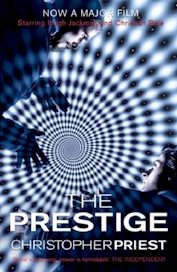 Having seen
the film adaptation of The Prestige
some years ago, I thought I knew what to expect from the book. I soon found
out, however, that it was a rather loosely based adaptation, with the main
characters and premise transplanted into an almost entirely different plot. Not
that it wasn’t good – I remember enjoying it and being surprised by the ending,
even if I had a lot of difficulty telling Hugh Jackman and Christian Bale
apart.
Having seen
the film adaptation of The Prestige
some years ago, I thought I knew what to expect from the book. I soon found
out, however, that it was a rather loosely based adaptation, with the main
characters and premise transplanted into an almost entirely different plot. Not
that it wasn’t good – I remember enjoying it and being surprised by the ending,
even if I had a lot of difficulty telling Hugh Jackman and Christian Bale
apart.
Perhaps
unsurprisingly, I have to say that I prefer the book – as with most film
adaptations, a lot of depth was lost in translation to the screen. The novel is
narrated by four different characters – two Victorian illusionists, and their
modern-day descendants. With each retelling of events, we learn more about what
occurred, and the differences in perspective between characters are clearly
shown. The reader can also get a better insight into each character
individually, as we read their views (in the form of dairies or notes, in the case
of the illusionists), and it is interesting to see the parallels between the
two men who make themselves sworn enemies.
It’s
explicitly stated in the novel that Borden and Angier’s feud really is petty,
and that both regret it at some point. For me, this adds a poignancy to the
fact that they helped to ruin each others’ lives for no major purpose. The
repercussions of the illusionists’ actions on their descendants 100 years later
also frames the narrative in a way that (if I remember rightly) is lacking in
the film.
The results
of operating the device Angier has Tesla create for his magic trick are less
melodramatic than in the film, but more spine-chilling for all that. Priest
creates a hint of the unnatural as well as the scientific, evoking almost an H
G Wells-like feel by the end as the full repercussions of Angier’s use of the
machine are felt.
As I
expected events to pan out the way they did in the film adaptation, parts of
the novel were a genuine surprise to me. I realised after finishing that, as
with any good magic trick, I hadn’t been given enough information to fully explain
events, but that, in the midst of the action, I hadn’t even noticed.
Well worth
reading if you’re a fan of the film, or even if you’re not. And if you enjoyed
reading this, watch the film! It’s different enough that it’ll still
surprise you.
Next up: Rumpole à la Carte, by John Mortimer
Saturday, 3 May 2014
The Way of Shadows - Brent Weeks
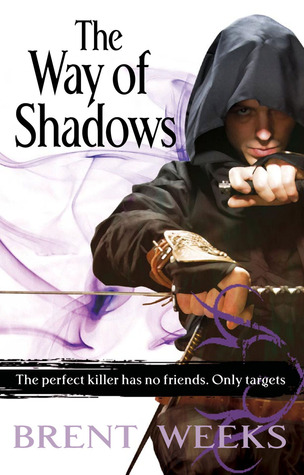 This was one
of those books you really can’t put down, and keep thinking about even once you’re
finished.
This was one
of those books you really can’t put down, and keep thinking about even once you’re
finished.
Azoth is a
young boy trying to survive in the brutal world of the slum guilds, who dreams
of becoming a wetboy (assassin aided by innate magical ability) like the
legendary and fearless Durzo Blint. He manages to get taken on as Blint’s
apprentice, and grows up in a world of intrigue, suspicion and plotting in his
new identity as Kylar Stern, dispossessed nobleman. We see Kylar/Azoth’s
progression from vulnerable urchin to professional killer, and his struggles to
keep those he loves safe in a dangerous world.
The only
negative thing I could say about The Way
of Shadows is that sometimes the wide range of cultures that meet in the
novel result in so many different cultures, titles, regions, and legends coming
together that it becomes difficult (or did for me) to remember all of them.
That said, the rich and diverse background to the novel really does give a
sense of the metropolis in which the novel is set. It’s quite possible the
reason I had difficulty remembering things was because I did most of the
reading on night shifts, where I was sleepy and frequently interrupted by the
need to do work.
There is a
wonderful intricacy in the way in which many different characters’ stories
intertwine, and in the way the consequences of someone’s actions change the
course of another character’s life. While the focus is on the protagonist, parts
of the prose are written from other points of view, which adds to the sense of
an interweaving pattern.
Throughout
the novel the action is fast-paced and compelling, if vivid and gruesome at
times. Plot twists and surprised leap out frequently, not just at the end, and
the reader is drawn in, wanting to discover more. There’s an ambiguity to it
that feels very human, rather than attempting to justify Kylar’s choice of
career on a moral level to make him likeable as a character. It isn’t just a
story about a boy becoming an assassin, it’s a story about hatred, love,
cruelty, betrayal, and redemption, and it’s well worth reading.
Next up: The Prestige, by Christopher Priest
Monday, 3 March 2014
Book Haul: Episode II
 I know, I really shouldn't have. But with paperbacks 50p each and hardbacks £1 at a local charity shop, I think it's a testament to my amazing self-restraint (and the fact that most of the selection available were romances or thrillers) that I came home with only 6 books.
Today's additions to my not-so-little family of books are Alice Sebold's The Lovely Bones, Christopher Priest's The Prestige, Jasper Fforde's The Eyre Affair, E M Delafield's The Diary of a Provincial Lady, Edward Marston's The Iron Horse, and Stephen Fry in America.
The first two I chose because I'm aware of the films (I've seen and enjoyed the film of The Prestige, but haven't seen The Lovely Bones yet), and I've read another Jasper Fford and loved it. I've heard good things about The Diary of a Provincial Lady, and other two just looked fun. Now to squeeze a little more space out of my bookshelves...
Subscribe to:
Posts (Atom)