This week's Booking Through Thursday is:
What book (or books) from your childhood do you think about most often? That had the most effect on your life?
I devoured books even as a child, but the ones that I really reread and took in most were Terry Pratchett's wonderful Discworld series. I read the lot (and the new ones as and when they came out) several times over, in chronological order, or sorted by character groups, and so on.
I also really loved Jane Austen's novels, particularly Pride and Prejudice and Persuasion. George Eliot's Middlemarch was another one - it was my gran's favourite book, and she gave me her own copy before she died. The variety of characters and the depth and complexity of their feelings and situations kept me coming back to reread it.
Showing posts with label George Eliot. Show all posts
Showing posts with label George Eliot. Show all posts
Sunday, 15 November 2015

Thursday, 12 June 2014
The Final Sacrament – James Forrester/Ian Mortimer
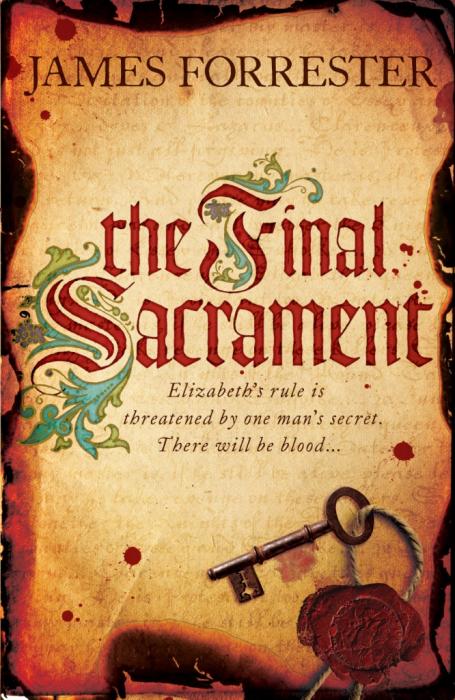
It’s not a
bad novel as such, I just found it hard to warm up to any of the characters,
especially Clarenceux, the protagonist. They all feel a little two-dimensional,
more like archetypes than rounded characters. It doesn’t help that Clarenceux
spends the majority of the novel worrying, which is understandable, as he is trying
to hide a pivotal document from important and powerful people while keeping
himself and his family safe. However, it means that a mostly negative and
slightly stressful feeling pervades the narrative – for me, the novel has too
much grief and not enough in the way of happiness to make it
really enjoyable.
Another
issue in reading this was the strange way the viewpoint switches between
characters. While it's told in the third person omniscient style, it’s more
usual to either change viewpoints strictly between sections (à la George R R Martin) or
to be a totally unbiased narrator, knowing everyone and everything (George
Eliot, for instance). Mortimer, however, casually switches viewpoints within the
space of a couple of sentences, and then returns to the original characters’
consciousness, which I found vaguely unsettling, rather like an out-of-body
experience.
The back
cover informs me that James Forrester is the pen name of historian Ian
Mortimer, so I went into this one expecting a lot of historical detail. I wasn’t
disappointed – this was where the novel really stood out for me. Mortimer’s
intimate knowledge of Elizabethan life shines through in Clarenceux’s pride in
his new glass windows, in the detailed description of a woman washing clothes,
or in the food eaten at a Christmas feast. Where many novels would
gloss over little details, we can really picture the minutiae of each scene,
which not only adds very much to the atmosphere but also taught me new things
about life at the time.
The downside
of this is that Mortimer seems to expect his audience to be just as knowledgeable
as he is on the subject of Elizabethan politics. The reader is thrown in at the
deep end with a discussion between Queen Elizabeth, Francis Walsingham and
William Cecil, with very little explanation of the background or motivations
for each character. I am interested in history, but not to the extent that I
feel so familiar enough with figures like Walsingham and Cecil that I don’t need
an introduction to them, as you would with fictional characters.
That said,
the momentum grew throughout the novel, and I found the ending genuinely
touching. While some aspects of the prose lack finesse, The Last Sacrament is a
well-researched and atmospheric novel, which left me feeling that I’d
learned something at the end of it.
Next up: Shadow’s Edge, by Brent Weeks
Subscribe to:
Comments (Atom)