This week's Booking Through Thursday is:
What’s the most beautiful thing you’ve ever read?
I don't know about the absolute most beautiful thing I've ever read, but I've copied several passages I've really liked over the years into a notebook I have. Two passages I thought were particularly well-crafted and are on beauty itself:
"When beauty is universal, it loses its power to move the heart, and only its absence can produce any emotional effect." - The City and the Stars, Arthur C Clarke
"Our muddling intellect
Mis-shapes the beauteous form of things:
We murder to dissect."
- The Tables Turned, William Wordsworth
Another phrase which I found particularly resonant is:
"This is the way the world ends
Not with a bang but a whimper."
- The Hollow Men, T S Eliot
Any favourite passages of your own?
Showing posts with label Arthur C Clarke. Show all posts
Showing posts with label Arthur C Clarke. Show all posts
Saturday, 4 July 2015

Saturday, 8 February 2014
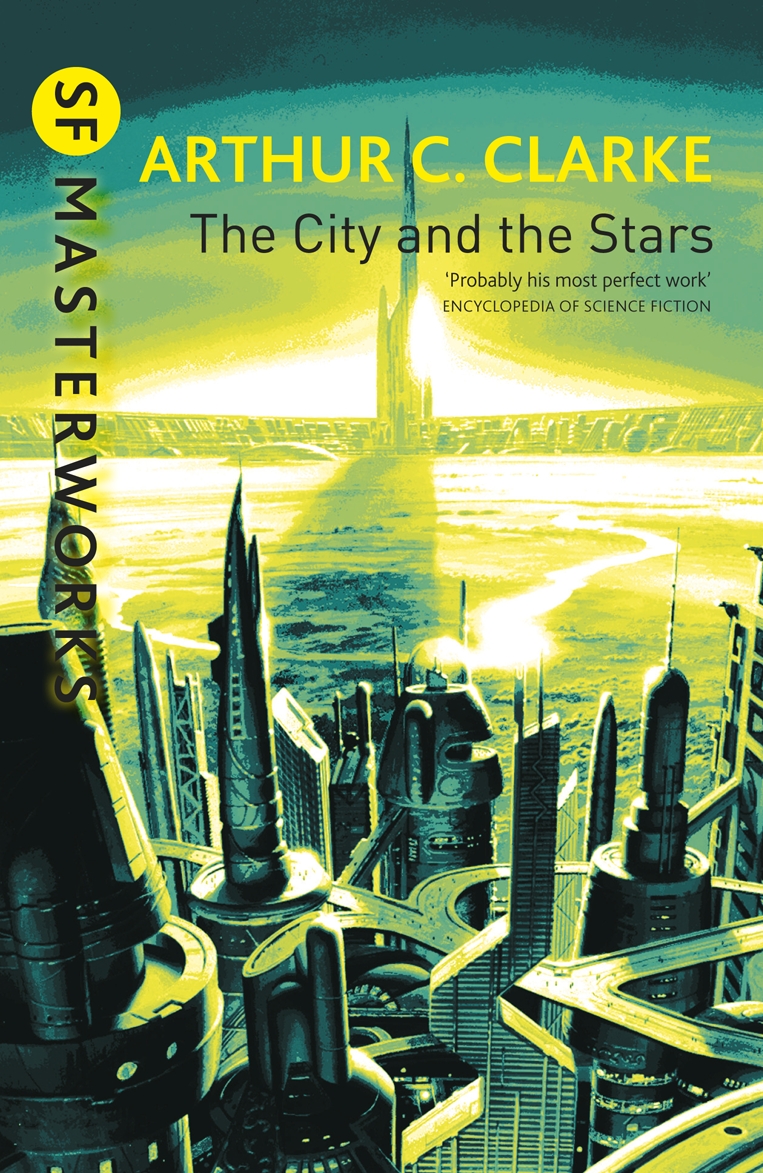
The City and the Stars - Arthur C Clarke
 I’ve always
loved early sci-fi for the sense of originality and exploration it gives. Modern
sci-fi can be great, but I find it’s often self-consciously aware of the
existing canon and tropes and always pushing to reach beyond them, whereas
sci-fi stories written in the 50s and 60s (and earlier!) seem eager to simply
explore their own ideas without being coloured by those of others.
I’ve always
loved early sci-fi for the sense of originality and exploration it gives. Modern
sci-fi can be great, but I find it’s often self-consciously aware of the
existing canon and tropes and always pushing to reach beyond them, whereas
sci-fi stories written in the 50s and 60s (and earlier!) seem eager to simply
explore their own ideas without being coloured by those of others.I have to admit I’ve never read any of Clarke’s other works (although 2001: A Space Odyssey has been on my must-read list for a long time), so I wasn’t sure what to expect from this one.
The City and the Stars opens, millions of years in the future, with the human race having developed a form of immortality in which, at the end of each life cycle, a person’s mind is stored by a super-computer and reborn into a new, fully formed adult body at a later date. This continual recycling of minds and the fact that physical reproduction no longer takes place has led to stagnation, and only one strictly enclosed city on Earth remains in existence.
What really
grabbed me and pulled me into this novel was this, at the end of Chapter
2:
‘You, Alvin, alone of the human race, have never lived before. In literal truth, you are the first child to be born on Earth for at least ten million years.’
‘You, Alvin, alone of the human race, have never lived before. In literal truth, you are the first child to be born on Earth for at least ten million years.’
The
protagonist, Alvin, is the only inhabitant of the city of Diaspur who is not
content to live encased in their safely regulated environment, and yearns to
escape and wander among the stars as his ancestors once did. His discoveries
overturn his established beliefs and set in motion events which have been anticipated
for millennia.
While many of the scientific technicalities have been glossed over or only vaguely alluded to (one habit of early sci-fi writers that does grate with me), The City and the Stars is a great exploration of stagnation vs. potential and the damaging effects of wilful ignorance. For me, the best science fiction is more about human nature than about science, and that certainly applies here.
So, if you want high-octane spaceship battles and slime-covered aliens biting peoples’ heads off, maybe this isn’t the science fiction for you, but if you like insightful, imaginative writing with a wonderful turn of phrase, Arthur C Clarke’s The City and the Stars is well worth reading.
Next up: The Sealed Letter, by Emma Donoghue
While many of the scientific technicalities have been glossed over or only vaguely alluded to (one habit of early sci-fi writers that does grate with me), The City and the Stars is a great exploration of stagnation vs. potential and the damaging effects of wilful ignorance. For me, the best science fiction is more about human nature than about science, and that certainly applies here.
So, if you want high-octane spaceship battles and slime-covered aliens biting peoples’ heads off, maybe this isn’t the science fiction for you, but if you like insightful, imaginative writing with a wonderful turn of phrase, Arthur C Clarke’s The City and the Stars is well worth reading.
Next up: The Sealed Letter, by Emma Donoghue
Thursday, 6 February 2014
Introduction time
My name is Edith, and I'm addicted to books.
I'm not quite exaggerating - as soon as I finish one book, I need to start the next one, even if that just means glancing at the first paragraph. I'll be writing my impressions of each book here (spoiler-free, to the best of my ability) as and when I finish reading them, in the hope that I can convince other people to read them too! The ones I enjoy, at least. I wouldn't encourage anyone to read books I hate, except occasionally for humour value.
Next up: The City and the Stars, by Arthur C Clarke
I'm not quite exaggerating - as soon as I finish one book, I need to start the next one, even if that just means glancing at the first paragraph. I'll be writing my impressions of each book here (spoiler-free, to the best of my ability) as and when I finish reading them, in the hope that I can convince other people to read them too! The ones I enjoy, at least. I wouldn't encourage anyone to read books I hate, except occasionally for humour value.
Next up: The City and the Stars, by Arthur C Clarke
Subscribe to:
Comments (Atom)