Showing posts with label mystery. Show all posts

Wednesday, 17 February 2016

A Trail of Ink - Mel Starr

The third novel in the medieval mystery Hugh de Singleton series focuses on the mysterious theft of his friend John Wycliffe's entire collection of books. His investigations lead him to several different groups of possible suspects, and to multiple attempts on his life as he tries to uncover the truth and retrieve the books. At the same time, he must try to win his beloved Kate from the latest of her persistent suitors.

Like the previous novels, A Trail of Ink is so rich in detail, especially in little everyday things like food, clothes or furnishings. This gives a real depth to the story and makes it more than just a mystery set in the past. Starr blends intrigue, action and comedy together to create a very readable novel that really brings the period alive.

Next up: Automated Alice by Jeff Noon

Friday, 15 January 2016

Film adaptation: Gone Girl

I was curious as to how the film adaptation of Gone Girl would show the story, as adaptation of an unreliable narrator and a plot where time skips about I imagine would be quite a challenge. As it turns out, they simply followed it the same way the book does, and I think it works very well.

In terms of casting, Ben Affleck is exactly as I'd imagined Nick, and while Rosamund Pike didn't initially look the way I'd pictured Amy (personally I thought of her as paler and a natural blonde), she acted the part very convincingly. The film also does a great job of showing externally what in the book is a lot of internal monologue, without turning it into people talking to themselves.

While some parts are a little streamlined, for instance the flashbacks to Amy and Nick's early relationship, or Nick's part in the investigation of Amy's disappearance, we still get enough detail and depth to get the full impact of the plot. In particular though I did feel it was a shame that Amy's relationship with her parents was mostly missed out.

The development of both Nick and Amy's characters is very well shown throughout, and even knowing the ending from the book the plot is well-paced and gripping. Not a pleasant or relaxing film, but definitely worth watching.

Monday, 11 January 2016

Film adaptation: And Then There Were None

This 3-part BBC adaptation is one of the most faithful novel adaptations I've seen in a while, which I was glad about as Christie's plots are so carefully and intricately thought out that tinkering with them generally makes them less effective. There was a surprisingly star-studded cast considering it was something I'd seen no advertising for (or maybe it's been out there but I just haven't seen any), including Charles Dance, Aidan Turner and Miranda Richardson, as well as Burn Gorman (another, less well-known face from Game of Thrones) and Anna Maxwell Martin.

The scenery of the island was wonderfully bleak and atmospheric, with the intentional contrast of the modern mundanity of the house itself as effective as in the novel. Seeing it all visually for me accentuated the characters' gradual descent into a kind of stress-induced madness, especially, although it might sound odd, in the women. I hadn't really thought about it before, but it seems rare to see middle or upper class women in period dramas in any state other than well-dressed and composed, so seeing the convention of decent dress and presentation gradually break down was very interesting.

In terms of changes, the largest one perhaps was a change from the solution to the murders being a found manuscript in the book to a live confession in the series, which does make sense as being more dramatic and easier to show in visual media. The crimes committed by the 10 guests were also changed for the most part, in a way that made them feel more deliberate and in many cases more violent. My own feeling is that this wasn't strictly necessary, but perhaps it does make the viewer less sorry to see them die as they are more culpable themselves.

Another common alteration to period adaptations that often frustrates me is the addition of sex where it's absent in the book, and this did take place here. I didn't actually mind it, however (and not only because Aidan Turner is very nice to look at), because the characters in question did have a sense of chemistry in the book, and their acting on it in the adaptation served to accentuate the sense of social boundaries and rules breaking down.

I hope I haven't accidentally given spoilers to anyone who doesn't know the story, but I will say it's definitely worth watching, and also reading.

Friday, 8 January 2016

Bonus review: And Then There Were None by Agatha Christie

I've had quite a few Agatha Christies on my bookshelf patiently waiting their turn to be read, but when I noticed the new BBC adaptation of And Then There Were None over the Christmas period I wanted to read the book before watching it.

The premise is pretty well-known: 10 people go to a house on an isolated island, and are killed one by one until they are all dead. In a foreword Christie herself comments on how challenging it was to think up a way to do this, and it really is a very clever and surprising solution.

This is one of the least cosy Christie novels I've read – usually the investigating figure, whoever they may be, is not personally involved in the murder and feels pretty safe in themselves. In And Then There Were None, however, the narrative viewpoint shifts between each of the characters as they become increasingly more aware of their own inevitable demise, which lends the story an unusually serious edge, more like a psychological horror than a comfortable murder-mystery.

The tone remains very grounded and British however, and Christie does a great job creating a variety of distinct but convincing narrative voices. In spite of the fact that they all have quite serious flaws, many of them are likable enough for me to have wished they didn't have to die.

One of Agatha Christie's best-known novels, and well worth a read.


Sunday, 20 December 2015

Bonus review: Gone Girl by Gillian Flynn

As my other books at the moment are a bit on the long, heavy side, I took some time out to read Gone Girl to break things up a bit.

Nick and Amy Dunne, a recently out-of-work couple from New York, have moved to Nick's much smaller hometown of North Carthage, Missouri, where Nick opens a bar with his twin sister Go. One day he returns home to find his wife unexpectedly missing, and his life is suddenly invaded by police investigations and harassing media.

The story is told in chapters that alternate between Nick's present-day experiences and diary entries written by Amy, and through these a picture builds up of the couple's turbulent relationship beneath their appearance of public normality. Both are flawed individuals with moments (or more than moments) of narrative in which they are unlikable but at the same time very relatable, and the alternating accounts of events by Nick and Amy build up and then strip away layers of deception and conflict.

While I wouldn't necessarily have chosen this novel myself from the blurb (it came recommended and lent by someone at work), it was actually a fascinating and gripping read, and highly original and unexpected.

Gone Girl is definitely worth reading, even if, like me, you prefer more of a plot-based story – trust me, you won't be disappointed.


Next up: Kristin Lavransdatter by Sigrid Undset

Thursday, 5 November 2015

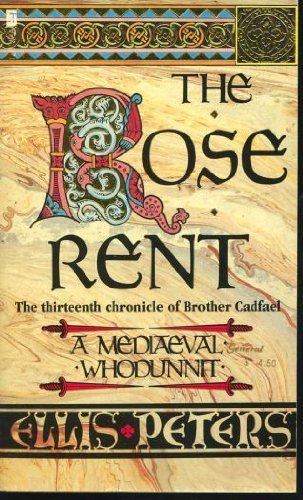
The Rose Rent - Ellis Peters

The thirteenth Cadfael novel, The Rose Rent, is a little bit more than a detective story. Young widow Judith Perle, who rents property to the abbey for the token price of a single rose delivered on the same day once every year, goes missing a couple of days before this rent is due, following the mysterious near-destruction of the rose bush in question. As the sheriff and the abbey are well aware, failed payment of this rent, would legally result in the property defaulting back to Mistress Perle, and puts suspicion on some of her would-be suitors would might aspire to own it themselves.

Ellis Peters uses more of an open style of narration than usual in this novel, and we see events from a diverse range of points of view. With an ingenuity worthy of Agatha Christie, this is cleverly used to hide facts in plain sight and to bring about a genuinely surprising ending.

The main point of this novel, for me, wasn't simply solving the original murder of a young monk found dead after defending the unlucky rose bush. It was more an exploration of grief and love, seeing the young widow begin to stop mourning her first husband and starting to move on with her life, and we see a wide selection of suitors each with their own agenda, all eager to marry into the prosperous business Judith has inherited.

Overall this novel felt more sophisticated as a plot than many of the preceding ones, and had an emotional complexity that really made it come alive.


Next up: Lullaby by Chuck Palahniuk

Tuesday, 15 September 2015

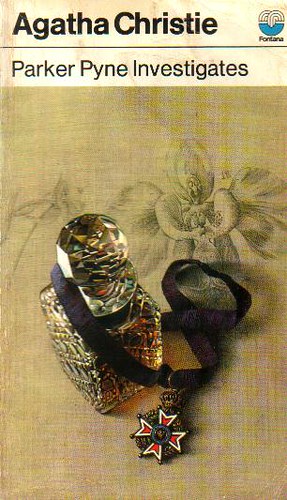
Parker Pyne Investigates - Agatha Christie

Parker Pyne Investigates is more a series of short stories than one novel, featuring Mr Parker Pyne, an ex-statistican who now consults for a living. He claims not to be a detective, and in fact he's almost the opposite of a detective – people come to him unhappy from insecurity in their marriage, dissatisfaction with their lifestyle, or simply out of boredom – and he secretly engineers events which push them in the direction of becoming happier.

The first half of the book has a collection of these 'consultation' stories in London, but the second half follows Mr Parker Pyne on a series of travels around the Middle East, Egypt and Greece, in which he finds himself reluctantly pulled into playing the detective even on holiday.

As a character Parker Pyne feels like a cross between Poirot and G K Chesterton's Father Brown. His apparently haphazard methods and understanding, stolid manner almost always lead to him succeeding somehow, and he takes success or the occasional failure with the same amiable placidity.

This collection of short stories feels almost like an artist's sketchbook, where an idea or concept for one of Christie's more complex plots is briefly sketched out and played with to explore its potential. The stories are amusing, ironic and full of trademark twists and good-humoured melodrama.

Overall, a light, pleasant read for any mystery fan.


Next up: Bridget Jones' Diary by Helen Fielding

Saturday, 22 August 2015

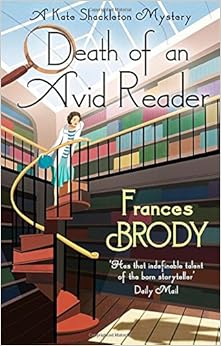
Death of an Avid Reader - Frances Brody

This looked as though it would be a fairly gentle Christie-imitation murder-mystery – a widowed lady-detective searching for the long-lost illegitimate daughter of a titled lady on her deathbed, while investigating the murder of a university professor found dead in her local library. This seems to be the second novel in a series, but enough was explained that I didn't feel left behind.

To begin with, the setting and characterisation ambled along, and it took me a while to warm up to Kate Shackleton, the central detective. However, around the halfway mark, the plot picked up the pace and the story became more intriguing, and I found myself really wanting to find out the answers.

Once I gave them time the characters rounded out more and the story began to feel more compelling, including some surprisingly gritty aspects for what seemed on the surface an essentially respectable detective story, and some genuinely surprising twists.

Overall, a slow start, but a detective novel which comes into its own and turns into a mostly pleasant, easy-to-read but still attention-grabbing story.


Next up: The Girl Who Kicked the Hornets' Nest by Stieg Larsson

Sunday, 7 June 2015

Lamentation - C J Sansom

In C J Sansom's most recent installment, hunchbacked medieval lawyer Matthew Shardlake is asked to help Queen Catherine Parr recover a compromising book revealing her controversial religious opinions, before it is brought to King Henry VIII and causes her downfall and possible execution. His efforts to discover the book entangle him with some of the most powerful figures in the realm and lead him into danger and self-doubt.

As with the previous novels in the series, one of the best things about this novel is the vividity of description Sansom uses to bring the reader into medieval London. We experience the sights, smells and sounds, and are jostled in the crowds along with Shardlake. I'm not ashamed to admit that much of my historical knowledge is taken from historical fiction, and getting to know historical characters and their deeds by almost experiencing them by proxy sticks in my mind much better than by trying to memorise dates and battles.

Sansom creates memorable, believable characters, and the plot twists and winds deviously with betrayal, double-bluffs, spies and infiltration. Lamentation is full of emotional depth as well as intrigue, and keeps you turning the pages right until the end.


Next up: The Definitive Guide to Screenwriting by Syd Field

Monday, 30 March 2015

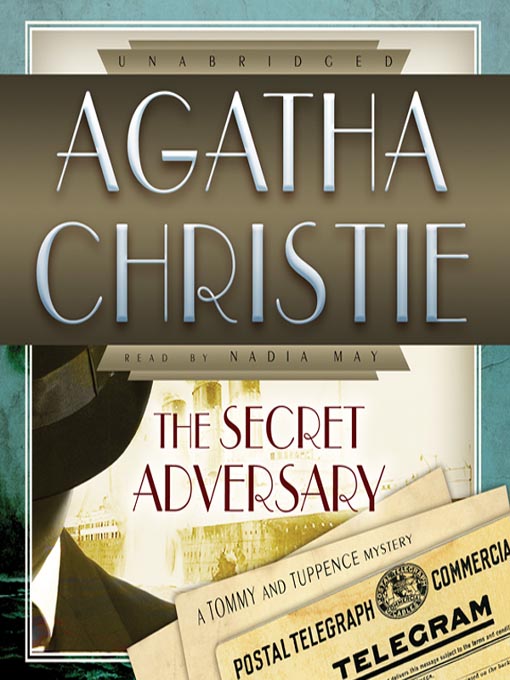
The Secret Adversary - Agatha Christie

The Secret Adversary is a proper old-fashioned adventure story in Agatha Christie form. 'Tuppence' Cowley and her childhood friend Tommy Beresford are unemployed and underfunded following the declaration of peace after World War I, and decide to make their fortunes by becoming adventurers. As luck would have it, their conversation is overheard by a rather suspicious man who offers them an equally suspicious job, and their investigations bring them into contact with an international gang bent on the destabalisation of the British Empire. At its head is the mysterious 'Mr Brown', who none of the gang members know the identity of, but each suspects it is one of his fellows.

Tuppence and Tommy race to find a girl, Jane Finn, who disappeared years ago with the pivotal package of documents on which the gang's plot hinges, with the aid of an imposing King's Councillor and Jane's cousin, an American millionaire.

This story has a fast-paced, light-hearted theatrical feel, with convenient amnesia, hidden document caches, and a high-speed car chase (with guns!). Great fun to read, with a devilishly thought out plot.


Next up: Le Chef-d'oeuvre inconnu by Honoré de Balzac

Wednesday, 25 March 2015

The Big Four - Agatha Christie

This is more a series of mini-adventures than one single novel, in which Hercule Poirot and his devoted friend Hastings try to thwart the plans of an international gang known as the Big Four in the quest for world domination. Despite the global influence of these criminal masterminds, Poirot engages them in a war of minds and strategy that has likely deadly consequences.

The Big Four is one of the most unashamedly entertaining Christie novels I've read, with a Shakespearean penchant for unfathomable disguises, plenty of melodramatic grandstanding, and a few satirical digs at the conventions of mystery-writing.

Seen from the sidekick Hastings' point of view, the reader is kept in the dark for much of the novel, while being given plenty of clues to make guesses at the resolution. A fun, light-hearted read of a detective novel.


Next up: The Secret Adversary by Agatha Christie (the last in this three-novel volume, and I'll move on to something different!)

Saturday, 21 March 2015

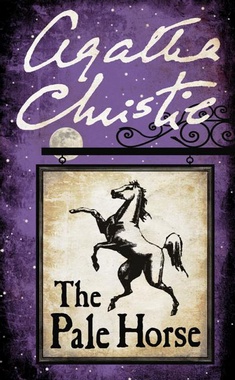
The Pale Horse - Agatha Christie

As detective novels go, this one stands out a long way - sinister, well crafted and very surprising, this has to be one of the most interesting Christie novels I've read so far.

A priest is called to the bedside of a dying woman in London, and comes away with a list of names scrawled on a scrap of paper. He is later found clubbed to death, and the mysterious list is the only clue the police have to solve the puzzle. Mark Easterbrook, an academic struggling for inspiration, gets involved tracking down the killer when his recently deceased godmother proves to be one of the names scribbled down. Every name on the list turns out to have recently died of apparently natural causes.

With his accomplice, a spirited young woman named Ginger, Easterbrook is led to a converted inn called the Pale Horse in a small country village, now the home of three women claiming to have occult powers.

Appearing as a supporting character is Mrs Oliver, a wonderfully satirical self-portrait by Christie of an abstracted, rambling mystery novelist, who lends the story a much-needed light-hearted aspect.

Rather than simply attempting to solve a murder, The Pale Horse plays with ideas of the supernatural and discusses fascinating psychological or psychosomatic concepts. Not only that, but the novel is very cleverly constructed, with oblique hints throughout and layers within layers hiding the answer. Very much recommended!


Next up: The Big Four by Agatha Christie

Sunday, 8 March 2015

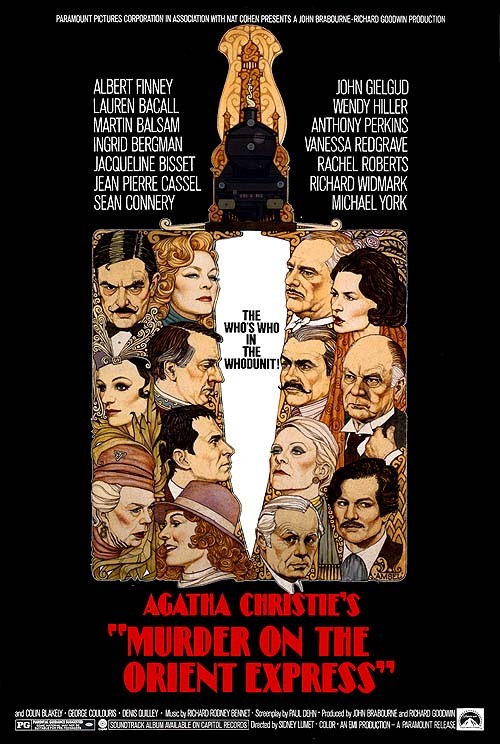
Film adaptation - Murder on the Orient Express

I read the novel quite a while ago, so watching this adaptation was long overdue. I went for the classic David Suchet 1974 version, and I have to say I love the old-style use of dramatic music to highlight key moments. I also liked the slow pace, which reflects the steady information-gathering of the book, and makes a nice change from modern films and TV where the angle or scene cuts once every few seconds.

For me David Suchet is THE Poirot, and Murder on the Orient Express had plenty of the compassion and understated humour that comes across in the novels. The slower, lingering shots added a wonderful sense of atmosphere.

Appearances by many other talented actors and Christie's signature plot twists made this an entertaining and engaging film to watch, even knowing the ending already. Good gentle fun, a long way from more recent (in my opinion rather stressful) gritty realism.

Saturday, 7 March 2015

World Book Day


In honour of the recent world book day (that's a good enough reason, right?) I did a little book shopping. As well as a promising-looking murder mystery set in the 20s I came away with 3 vintage-facsimile hardback Agatha Christies - I just love those covers.

Did anyone else do or pick up anything nice for world book day?


Sunday, 22 February 2015

A Corpse at St Andrew's Chapel - Mel Starr

I've been looking forward to this one ever since reading the first novel in this series, The Unquiet Bones, and I wasn't disappointed by the sequel.

Hugh de Singleton is a candid but openly flawed narrator, admitting when he takes credit for things he shouldn't or deceives by omission. He has no pretensions of being a hero, or even of being a particularly good bailiff, but sets out to do his duty as well as he can. As in the first novel, he does have progressive views on things - religion in particular, in this book - but his mindset is definitely more medieval than modern.

The beadle of the manor is found apparently mauled by a wild animal, but missing his shoes. When those shoes appear on the feet of one of the villagers, questions need to be asked that lead to much more than a simple wolf attack.

There are some wonderful historical details, for instance belches being a polite way to flatter your host by complimenting their dinner, and Hugh (like me!) takes pleasure in his meals, listing the dishes eaten and the manner in which they were served.

The mystery itself meanders through several different possibilities before finally discovering the truth. Hugh approaches his investigations in a Poirot-like manner, gathering most of his evidence from his knowledge of human beings and not from cold analysis.

A fascinating and immersive sequel from Mel Starr - the only bad thing is that this story ends on a cliffhanger leading into the next novel, and I don't have it so I can't read it right away!


Next up: The Adventures of Sally by P G Wodehouse

Sunday, 7 December 2014

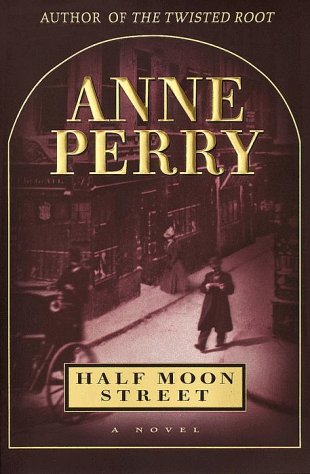
Half Moon Street - Anne Perry

As a murder mystery, this is an odd one. While there is a murder to be solved, and the themes of the novel add to our understanding of the case, this is really more of a period drama with added murder-mystery.

A body is found shackled to a dingy on the Thames, a man dressed in a woman's gown and strewn with flowers in the style of Ophelia. Superintendent Thomas Pitt tries to discover the dead man's identity, and finds himself thrust into the theatrical world of actors and photographers.

What feels like the main focus of the novel, however, is the marital relationships of three couples: first, Pitt and his wife Charlotte, currently on holiday in Paris, who he misses greatly and thinks of with tenderness. Charlotte's mother, Caroline, who remarried after the death of her first husband to an actor 17 years her junior, feels insecure about the age difference and worries she may be too old-fashioned for him. Her widowed mother-in-law, Mariah Ellison, who is staying with them, is still haunted by memories of her abusive husband.

The lives of these three very different couples, linked into one extended family, intertwine and affect each other in subtle and moving ways. There is a lot of consideration given to concealment and censorship, both with regards to artistic creation and to personal relationships.

It really is the social dramas within this novel that stayed with me, rather than the murder, which is thrust onto the sidelines a bit. I feel as though the blurb would be better off mentioning this rather than presenting it as a traditional detective novel, but all the same I enjoyed it – it gives a very compassionate view of the challenges of living honestly in a society bound by strict social convention.


Next up: Bitterblue by Kristin Cashore

Tuesday, 25 November 2014

The Face of a Stranger - Anne Perry


This novel really stood out for me among other detective fiction. For one thing, it begins very unexpectedly – with the detective having entirely lost his memory following a carriage accident in which he suffered head injuries. William Monk’s sense of loss and his discomfort with feeling at odds with his former self are portrayed well throughout the novel. The other thing that sets it apart is the fact that, as well as the central mystery, this story is very much about people. They aren’t merely pieces in a puzzle, but feel like well-rounded characters with a past and a future. You really come to care about their fates in a way that I don’t often find in detective series.

The only negative thing I have to say about The Face of a Stranger is that it does tend towards being anachronistic in its values. Monk feels contempt towards his former self’s apparent social mobility, now thinking of the upper classes as no better than the lower, and the female protagonist, Miss Hester Latterly, is predictably independent with no patience for convention. Both characters are well-drawn and compelling, but neither really seem to suit the environment in which they’re placed. That said, it’s very hard to find historical novels that don’t modernise the views of the central characters to some extent.

The central mystery itself is cleverly done, and very human rather than being a contorted logical puzzle, which fits the tone of the novel very well. Definitely worth reading!


Next up: Half Moon Street by Anne Perry

Sunday, 9 November 2014

Absolution by Murder - Peter Tremayne


664AD has to be the earliest-set detective story I’ve read so far. Absolution by Murder is set during the Synod of Whitby, where religious delegates from the rival Christian factions of Rome and Iona met to decide the future of the kingdom of Northumbria. When a visiting Irish abbess is discovered in her room with her throat cut, Sister Fidelma, an Irish religieuse qualified to investigate legal matters in her own country, is asked to find the killer. Alongside a Saxon Brother, Eadulf, she races to uncover the murderer before rumours between the two factions spark a civil war.

Initially I found this novel difficult to get into, as the beginning is extremely heavy on early medieval religious history and politics, and the unfamiliar Saxon names also made it easy for me to mix up some of the characters. Once the action had really started, however, it became much more enjoyable.

Sister Fidelma is a refreshingly strong, forthright female detective, not taking sidekick position to her male counterpart, and refusing to defer to the expectations of the men she interacts with. Apparently this sexual equality is historically accurate, which makes a pleasant change to modern values being copied and pasted onto historical situations.

Overall, rather a slow start, but bear with it and it’s definitely worth it – enjoyable and intriguing reading, with plenty of historical ambiance.


Next up: Brave New World by Aldous Huxley

Tuesday, 21 October 2014

A few murder mysteries

I've got this week off work, and on the way back from a food shop I took a look in the charity shops to see if there were any books that appealed. This is today's chosen few:

A Rare Interest in Corpses by Ann Granger
Endless Night by Agatha Christie
Snow Falling on Cedars by David Guterson

I'm always interested in more Christie novels, and people have been telling me to read Snow Falling on Cedars for some time. At least, I think so, unless I've got the name confused with something else. The blurb sounded good, anyway.

Thursday, 16 October 2014

The Seven Dials Mystery - Agatha Christie


This Agatha Christie novel has a charmingly light-hearted tone reminiscent of P G Wodehouse. The heroine and detective is Lady Eileen Brent, ‘Bundle’ to her friends, who gets caught up investigating the murder of a young man who was killed in her own bedroom while the house was being let to a steel magnate. Her discoveries lead her to the mysterious Seven Dials secret society, and in true Christie style, the ending turns our preconceptions on their heads.

The cosy, jolly style makes this book very readable, and plenty of amusing social situations and misunderstandings occur. Our suspicions shift constantly, and Christie keeps you guessing right until the big reveal. Great fun to read, and much lighter in feel than many of her novels.


Next up: Touch of Power by Maria V Snyder