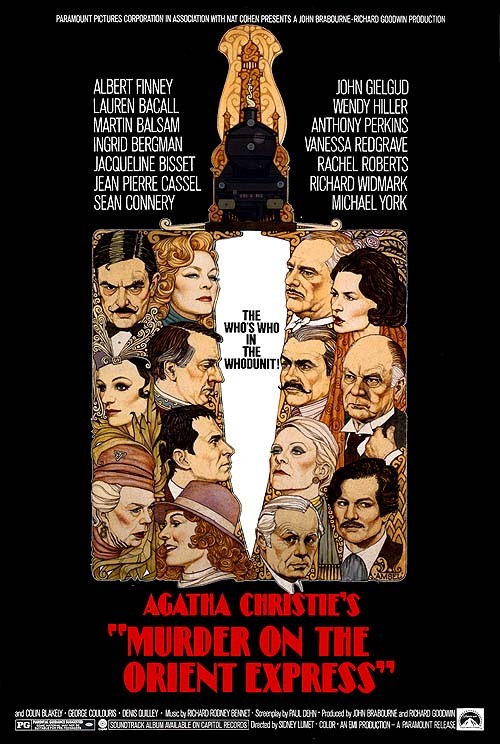
Murder on the Orient Express
 seemed
like apt reading material for the 6-hour train journey to my graduation ceremony
at the weekend, although it did make me long for the lovely old-fashioned
trains portrayed in the book, instead of the crowded, greasy and boiling hot
ones I was stuck on at the time.
We begin
with Hercule Poirot travelling back to London, after solving a case in Syria.
He plans to break his journey for three days exploring Stamboul (or Istanbul,
as we now know it), but receives an urgent telegraph to return home immediately.
He bumps into a friend of his who happens to be a director of the railway
company owning the Orient Express, who pulls some strings and gets him a
last-minute berth in an unseasonably crowded train bound for London.
Once on the
train, he meets a couple of his former travelling companions, who seem now to
be avoiding one another, as well as making the acquaintance of the diverse range
of other passengers on the carriage. After a day or two of travel, the train is
halted by a snowdrift, and in the morning one of the passengers is discovered
murdered. Trapped on a train with the murderer, and without the facility of
telegramming for further information about his suspects, Poirot must puzzle out
the identity of the culprit using his deductive powers alone.
As usual
with Agatha Christie, the plot keeps you guessing throughout, and I felt rather
smug at having spotted a pivotal clue at the time it happened. Naturally, the conclusion
is rather contrived compared to modern, gritty detective dramas, but that’s one
of the great things about Christie’s novels – you have the pleasant sensation
of sitting safely outside the action, watching what’s going on and wondering about
the solution.
Hercule
Poirot’s warm, amiable character and strong sense of compassion and humour is
also a nice contrast from other early detective fiction, for instance Sherlock
Holmes’ cold intellectual logic. For Holmes each crime is simply a puzzle to be
clinically solved and the culprit handed over to the authorities for justice,
but Poirot sees each suspect as a human being, and uses this to his advantage
when making his deductions.
Next up: Legend by David Gemmell