Monday, 30 March 2015

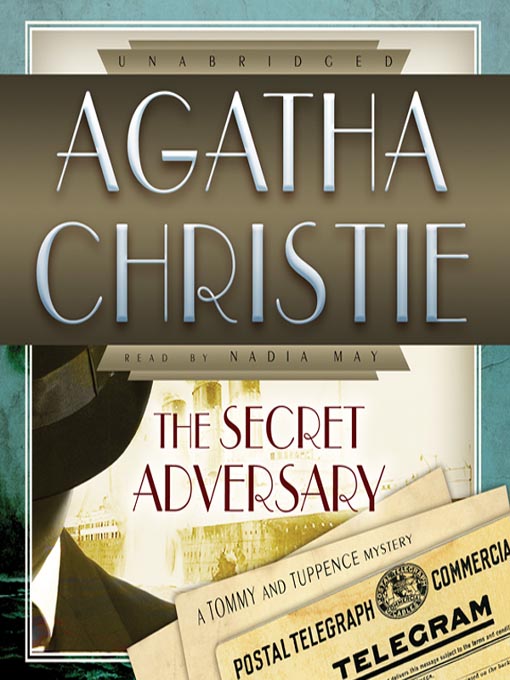
The Secret Adversary - Agatha Christie

The Secret Adversary is a proper old-fashioned adventure story in Agatha Christie form. 'Tuppence' Cowley and her childhood friend Tommy Beresford are unemployed and underfunded following the declaration of peace after World War I, and decide to make their fortunes by becoming adventurers. As luck would have it, their conversation is overheard by a rather suspicious man who offers them an equally suspicious job, and their investigations bring them into contact with an international gang bent on the destabalisation of the British Empire. At its head is the mysterious 'Mr Brown', who none of the gang members know the identity of, but each suspects it is one of his fellows.

Tuppence and Tommy race to find a girl, Jane Finn, who disappeared years ago with the pivotal package of documents on which the gang's plot hinges, with the aid of an imposing King's Councillor and Jane's cousin, an American millionaire.

This story has a fast-paced, light-hearted theatrical feel, with convenient amnesia, hidden document caches, and a high-speed car chase (with guns!). Great fun to read, with a devilishly thought out plot.


Next up: Le Chef-d'oeuvre inconnu by Honoré de Balzac

Saturday, 28 March 2015

Book vs film results

So a week ago I set up a couple of polls on www.listchallenges.com, to find out the relative popularity of books against their film adaptations. Here are the results, from a sample size of 225 on the book survey and 181 on the film survey (click for a larger, legible version. Books are in blue, films in red):

The most read books were:

1) Harry Potter series: 82%
2) Hunger Games series: 66%
3) Alice in Wonderland: 64%
4) The Diary of Anne Frank: 63%
5) The Hobbit: 61%
=6) The Chronicles of Narnia: 57%
=6) A Christmas Carol: 57%
=6) Mockingjay: 57%
=6) Pride and Prejudice: 57%
10) The Twilight series: 56%


and the most watched films:  
4) The Lord of the Rings trilogy: 77%
=6) Mean Girls: 69%
=6) Jaws: 69%
=9) Twilight (2008): 63%


The lead read books were:

1) Barry Lyndon: 1%
=2) Queen Bees and Wannabes: 2%
=2) Ross Poldark: 2%
=2) Martin Chuzzlewit: 2%
=2) Barnaby Rudge: 2%
=2) The First Men in the Moon: 2%
=2) Dombey and Son: 2%
=8) Bel-Ami: 3%
=8) Father Brown: 3%
=10) The Prestige: 4%
=10) Starter for Ten: 4%
=10) Little Dorrit: 4%
=10) The Mystery of Edwin Drood: 4%


and the least watched films were:

=100) Dombey and Son (1919): 0%
=100) Hard Times (1994): 0%
=98) The First Men in the Moon (2010): 1%
=98) Barnaby Rudge: 1%
=98) The Woman in White (1998): 1%
=94) Martin Chuzzlewit (1994): 2%
=94) A Tale of Two Cities (1980): 2%
=92) The Old Curiosity Shop (2007): 3%
=92) War and Peace (2007): 3%


The largest differences between reading and watching were:

- 67% more watched Mean Girls than read Queen Bees and Wannabes (maybe not surprising as it's a self-help book and a very funny film starring well-known actors)
- 54% more watched Jaws than read the novel
- 52% more watched Disney's animated The Hunchback of Notre Dame than read Hugo's novel (again, not very surprising, given that the film is an easy-access Disney production and the novel is a bit of a dense brick by most peoples' standards)
- 48% more read The Diary of Anne Frank than watched the film. I also discovered that The Diary of Anne Frank is on Goodreads' list of 'worst endings' - a bit of a controversial judgement, surely? It's not as though she ended it that way on purpose.
- 40% more have watched The Princess Bride and The Prestige than have read the novels. Personally I found The Princess Bride to be one of the few books I enjoyed much less than the film, due to the intrusive narrative voice and the fantastic film cast. Non-readers are really missing out on The Prestige, though - it adds a lot that isn't in the film.

I hope that if you're a bit of a statistics nerd, like me, you've found this fairly interesting. Take a look at the graphs for more details!

Friday, 27 March 2015

Constant companion

This week's Booking Through Thursday is:

Do you carry a book around with you? Inside the house? Whenever you go out? Always, everywhere, it’s practically glued to your fingers?
(And yes, digital books very much DO count as long as you’re spending time reading on your Kindle or iPad and not just loading them with books that you never actually read.)

Yes, I definitely carry a book with me almost everywhere I go. I only carry it around my own house when I'm going to be cooking, as then I can read it while stirring things - I don't feel the need to take it to the bathroom and I'm certainly not reading in the shower.

I always take a book when I'm going anywhere with a chance of waiting - for lunch breaks at work, queues in supermarkets, doctor's appointments - and definitely when travelling, I'll bring about 2 books more than I think I can get through in that time because the idea of maybe running out is just awful.

They're always physical books and not digital, I've never really got into reading on Kindle. It just doesn't feel like a book to me, it loses a lot of its character. I can see the logical convenience of it all, but it just doesn't count as a book in my head.

Wednesday, 25 March 2015

The Big Four - Agatha Christie

This is more a series of mini-adventures than one single novel, in which Hercule Poirot and his devoted friend Hastings try to thwart the plans of an international gang known as the Big Four in the quest for world domination. Despite the global influence of these criminal masterminds, Poirot engages them in a war of minds and strategy that has likely deadly consequences.

The Big Four is one of the most unashamedly entertaining Christie novels I've read, with a Shakespearean penchant for unfathomable disguises, plenty of melodramatic grandstanding, and a few satirical digs at the conventions of mystery-writing.

Seen from the sidekick Hastings' point of view, the reader is kept in the dark for much of the novel, while being given plenty of clues to make guesses at the resolution. A fun, light-hearted read of a detective novel.


Next up: The Secret Adversary by Agatha Christie (the last in this three-novel volume, and I'll move on to something different!)

Sunday, 22 March 2015

Book-to-film polls

I've made a couple of lists of book-to-film adaptations, as I'm interested to see how popular the books and films are in comparison with each other. I'll share the results when I have a fair sample of users.

Take part here: http://www.listchallenges.com/books-with-screen-adaptations
and here: http://www.listchallenges.com/screen-adaptations

Saturday, 21 March 2015

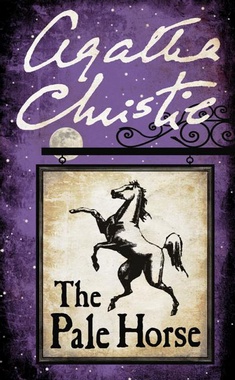
The Pale Horse - Agatha Christie

As detective novels go, this one stands out a long way - sinister, well crafted and very surprising, this has to be one of the most interesting Christie novels I've read so far.

A priest is called to the bedside of a dying woman in London, and comes away with a list of names scrawled on a scrap of paper. He is later found clubbed to death, and the mysterious list is the only clue the police have to solve the puzzle. Mark Easterbrook, an academic struggling for inspiration, gets involved tracking down the killer when his recently deceased godmother proves to be one of the names scribbled down. Every name on the list turns out to have recently died of apparently natural causes.

With his accomplice, a spirited young woman named Ginger, Easterbrook is led to a converted inn called the Pale Horse in a small country village, now the home of three women claiming to have occult powers.

Appearing as a supporting character is Mrs Oliver, a wonderfully satirical self-portrait by Christie of an abstracted, rambling mystery novelist, who lends the story a much-needed light-hearted aspect.

Rather than simply attempting to solve a murder, The Pale Horse plays with ideas of the supernatural and discusses fascinating psychological or psychosomatic concepts. Not only that, but the novel is very cleverly constructed, with oblique hints throughout and layers within layers hiding the answer. Very much recommended!


Next up: The Big Four by Agatha Christie

Wednesday, 18 March 2015

Ross Poldark - Winston Graham

I've had the first 3 novels in this series for a little while now, but the BBC adaptation airing reminded me that I ought to actually read them (or at least the first one) before I watch it.

The titular character, Ross Poldark, returns from fighting in the American civil war to find that his childhood sweetheart is on the brink of marrying his cousin. Plunged into a wave of depression and disillusionment, he cuts himself off from the rest of the family and tries to carve out a life for himself from the ruins of his father's land.

Stylistically, I found this novel a little odd - Graham does an excellent job using the linguistic style of the time period, and his local dialects add a lot of flavour to the text. However, the sense of realism portrayed in the structure of the plot and the sections of unreliable narration during times of great emotion for the characters feel much more modern. Ross Poldark is a convincing historical pastiche language-wise, but tells the story in a modern manner.

It's the start of a typical family saga in that we see the points of view of most of the characters involved, and follow their innermost feelings in great detail for short spaces of time. In that way it reminded me of The Forsyte Saga, in that not very much technically happens, but in a very personal and involving way. The depth and attention to detail in which each character's thoughts are described means that by the end you feel as though you've known all of them personally for a long time.

Now that's finished, I can check out what the BBC adaptation's like!


PS. How fantastic is his matador cape on the cover?


Next up: The Pale Horse by Agatha Christie