Showing posts with label books. Show all posts

Tuesday, 9 September 2014

The Diary of a Provincial Lady - E M Delafield


If Bridget Jones had been a 1920s housewife, this would be her. The fictional diaries of the unnamed Provincial Lady document the daily life of the well-intentioned, self-conscious and scathingly sarcastic narrator. We are shown her family life in a small village in Devon, and in the sequels follow her on a tour of America and to London during WWII.

While not very much “happens”, as such, the wonderful turns of phrase and the diarist’s acerbic observations on human nature had me sniggering rather loudly in the canteen at work. My boyfriend picked it up at one point, glanced down the page and asked me when it was written. When I told him the 1930s, he said that he hadn’t realised people were so sarcastic in those days.

The Diary of a Provincial Lady defies the common preconception that older books tend to be quite polite and sedate, and instead looks with a keen sense of the ridiculous at peoples’ everyday habits and tendencies. A cleverly written series of books that have the feel of sitting down for a cup of tea and a gossip with an old friend - perfect for curling up with at the end of a long day.


Next up: The Girl Who Played with Fire by Stieg Larsson

Saturday, 16 August 2014

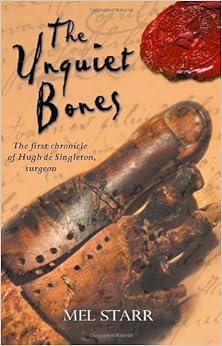
The Unquiet Bones - Melvin R Starr


I was struck from the very beginning of this novel by the style of the prose. The story is framed as an account in the first person by Hugh de Singleton, a young surgeon investigating the murder of a girl found in the cesspit of his patron’s castle. The language is uncomplicated with no aspirations to poetic beauty, but instead has a wonderful clarity to it. The narrator’s candid honesty and independent mind made this a joy to read, and gave me the feeling that if Hugh de Singleton were a real person, he’d be someone I’d very much like to know.

Another advantage Starr’s novel has over most historical stories is that the narrator is, himself, imbued with medieval values. Too often, authors simply place a character with modern attitudes in an historical setting, with no real consideration for how they could possibly have developed in a way so different to everyone else at the time. Of course, for the reader to relate to the protagonist we must have points in common – and in The Unquiet Bones Hugh is very much a progressive, but in a way that could have been possible at the time. While he favours contemporaneous modern medical theories, and believes in bathing even in winter, he still takes the social status quo for granted and respects its boundaries.

As usual when historians turn to writing fiction, this novel is full of great little details that add to the atmosphere and to the genuine feel of the time. Everything from the seating and food at dinner to some rather graphic surgical descriptions and a thorough understanding of the different clothing styles allowed to various social classes is included. These facts aren’t thrust in the face of the reader, however, but taken for granted by the narrator as common knowledge.

The central mystery itself is well thought out and takes several twists and turns before reaching its conclusion, and we get to know several ancillary characters as the story progresses, which makes a nice change from most murder mysteries, in which the characters encountered are often just there as parts of the puzzle.

This one was a very pleasant surprise, and I’m happy to discover that there are 6 more left in the series.


Next up: The Diary of a Provincial Lady by E M Delafield

Monday, 11 August 2014

Wordsworth's Poetical Works


Surprise bonus post!


I’ve posted a couple of poems out of my lovely antique Wordsworth before – but now I’ve finally finished it. It’s taken about 9 months to work my way through it, so it’s kind of a relief to have it out of the way now.

Many of his shorter poems are beautiful and pensive, or stirring with action and violence, but a lot of them, especially the longer ones, were harder to get through. I pride myself on never quitting once I start reading something, but even I couldn’t force myself to finish The Excursion, a 181-page blank verse epic consisting (judging from the first 30 pages or so) of the narrator wandering around the hills chatting to random people he meets and admiring the landscape.

It is a beautiful edition, and pretty old – there’s an inscription at the front dated 1867. Just holding a book that old feels wonderful, and it’s in great condition too considering it’s ex libris. Makes you think not that many people must have wanted to borrow it! Most of the gold leaf on the cover and outer pages remains, and the wonderful smooth leather feels amazing to hold. I wish people put as much effort into bookbinding as they did in those days. A book was forever, not just a throwaway read for the summer holidays, to be left on the train on the way home.

Sunday, 10 August 2014

Graceling - Kristin Cashore


Graceling came with the rather dubious recommendation, “[This] exquisitely drawn romance … will slake the thirst of Twilight fans”, on the front cover. However, I really enjoyed Fire, so I went ahead and read it anyway.

While it doesn’t quite have the accomplished sense of depth of Fire, this is Cashore’s debut novel, and as such that’s simply a sign that her novels have developed since the beginning. She does a good job of introducing us to the fantasy world the story takes place in, without being artificially explanatory or giving us too many made-up terms to try and remember.

The heroine, Katsa, is a graceling, marked out by her mismatched eyes and an uncanny natural ability – in her case, the ability to inflict violence. Ever since her gift was discovered, her uncle the King has been using her as a tool of intimidation against those who displeased him. A chance to investigate the mysterious kidnapping of a neighbouring King's father offers her an opportunity to escape and to prove to herself and others that she’s more than just a mindless thug.

One of the things that really stood out about this novel was the unusual angles we see events from. Katsa is an unconventional young woman, but this is only to be expected as the heroine of a young adult fantasy novel. However, the feel of the narrative is also different – while the novel appears to be of the standard ‘vanquish the villain’ type, you get the feeling that defeating the bad guy wasn’t really what it was all about.

The Twilight-style epic romance promised on the cover was, thankfully, more human and believable than that, albeit made more complex by the respective graceling abilities of the pair involved. This novel is populated by strong characters throughout, and we also meet Princess Bitterblue, the protagonist of the third and final novel in the trilogy. Despite being a child, she's forthright and intriguing, and I’m really looking forward to reading more about her.


Next up: The Unquiet Bones by Mel Starr

Saturday, 9 August 2014

A little accidental book shopping


On my way to do a sensible food, washing up liquid etc. shop this afternoon I gave into temptation and went into the two (two! next door to each other) charity shops that I have to pass to get into town. The result is as follows:

The Heart of a Hospital, by Anne Vinton. A vintage Mills & Boon - looks hilarious.
The Kite Runner, by Khaled Hosseini.
As Meat Loves Salt, by Maria McCann.
The Girl Who Played with Fire and The Girl Who Kicked the Hornets' Nest, by Stieg Larsson. I read the first novel last year, and have been meaning to get hold of these for a while. I only ever came across the third novel until today.

Now to try and find space to fit these into my extended literary family...

Wednesday, 30 July 2014

The Raven in the Foregate - Ellis Peters

This is a thought-provoking but comfortable story, which begins with a new priest taking the living of the local parish. Father Ailnoth is brilliant, educated, devout, austere - he has everything, in fact, except for the smallest hint of mercy or humility. In spite of his graces, his strict adherence to the letter of the law and his preference for correctness over human kindness soon makes him hated in the parish. When he is found dead in the mill-pond on Christmas Day, there are only too many suspects.

Suspicion rests on the young man helping in Cadfael's gardens, who arrived with the priest as nephew to his housekeeper. As pressure builds for a murderer to be uncovered, Cadfael tries to shelter his young assistant and discover the true culprit.

As usual, the tiny details are spot on historically and add very much to the atmosphere and depth of this novel. Cadfael's benevolent, forgiving attitude and his willingness to aid young people in love give a feeling of warmth and hope not often found in murder mysteries.

Another beautifully written and intriguing novel by Ellis Peters.


Next up: Graceling by Kristin Cashore

Sunday, 27 July 2014

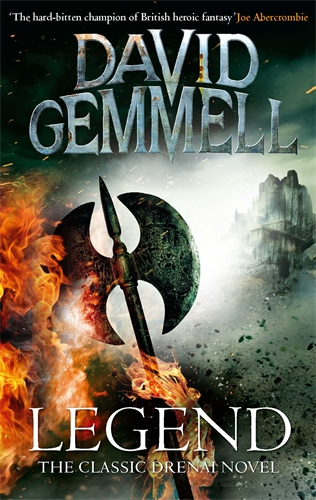
Legend - David Gemmell


I wouldn’t normally choose something quite as… battly, but this one came recommended so I thought I’d give it a try.

The writing style doesn’t have much finesse, but then it was Gemmell’s debut novel, so it’s quite possible he improves over time. Another criticism would be that he really doesn’t understand women – the point of view shifts between characters throughout, and the women are a little odd, to say the least.

That said, the events of the novel are suitably epic, with the odd real-world historical echo in there. The central character, Rek, falls in love with and marries the daughter of an earl, whose fortress is in danger of attack by a vast invading army. He reluctantly joins the siege to defend what is now his family’s holdings, along with the aging legendary warrior Druss.

Gemmell conjures up some interesting concepts, for instance the group of thirty warrior-monks (with the ability to see the future), and toys with ideas of the after-life. To my personal taste, I would have preferred more detail on these, and on the lives of the characters we meet, than so much description spent on military and strategic proceedings and the minutiae of the siege. There were some very gripping action sequences, however, and some touching moments.

All in all, I get the impression that this is a very manly book, with the emphasis on heroic action. Not exactly to my taste, but if that’s what you want, Gemmell’s Drenai series can provide it!


Next up: The Raven in the Foregate by Ellis Peters