This week's Booking Through Thursday is:
Does the price of a book affect your decision about buying it? Do you wait for cheaper editions of books you want?
For me, yes, definitely. I've never had much money spare, so price is one of the first things I look at when buying anything. If it's a relatively new second-hand book, I limit myself to about £3 each (sometimes a bit more if it's a very long book - it feels like better value somehow, even though I know words don't really work that way). If it's an old edition (1940s or older counts as old for me, and a nicely bound edition is a bonus) then I will consider paying more, up to about £10 for a particularly beautiful edition of something 100 years old or more. Of course, if I found a first edition or one signed by the author then I'd be prepared to give much more for it.
I generally don't buy new, freshly printed books unless I have a gift voucher, or if they're very cheap. That said, if it's one of the few currently writing authors that I really love, I'll pre-order their novels on Amazon, which works out cheaper than chain bookshops and means I get sent them as soon as they're released. Annoyingly, the letterbox in my current place is too small to fit hardbacks through, which means walking out to the postal depot to rescue my new editions from the clutches of the Royal Mail.
Friday, 11 April 2014

Tuesday, 8 April 2014
Heartstone - C J Sansom
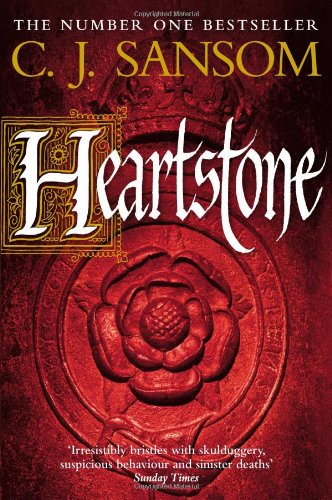 Heartstone, the fifth in Sansom’s
Shardlake series, continues the adventures of hunchbacked lawyer Matthew
Shardlake. In this novel Shardlake travels to Portsmouth to investigate claims
of abuse of a wardship trust, and to look into events that put a friend of his
into Bedlam nineteen years previously.
Heartstone, the fifth in Sansom’s
Shardlake series, continues the adventures of hunchbacked lawyer Matthew
Shardlake. In this novel Shardlake travels to Portsmouth to investigate claims
of abuse of a wardship trust, and to look into events that put a friend of his
into Bedlam nineteen years previously.
Once again,
Sansom really shines in his vivid descriptions of Tudor life – not only do you
get the sights and sounds of the time, but the smells, physical sensations, and
everyday inconveniences. Even descriptions of naval skirmishes with the French
are gripping, and really put you into the heart of the action, and I normally
get rather bored during battle descriptions. The bustling military encampments,
overcrowded cities and (on the surface) serene, secluded country estates all
leap off the page and into the mind’s eye. Maps of Shardlake’s journey and of
the areas he visits really add to the immersive quality of the story and allow
the reader to trace, in physical terms, the location of the action.
I did find
this novel slightly less enjoyable to read than its predecessors, in part
perhaps because so few of the characters the reader spends most of the time with are likeable.
There is a sense of frustration during parts of the narrative where
investigations seem to be going round in circles, which certainly mirrors that
felt by the protagonist, but makes for more difficult reading. That said, the
dénouement turns assumptions on their head and puts a new perspective on
events.
Historical
cameos featuring Henry VII, Catherine Parr and the Mary Rose, among others, are done deftly and without ostentation, blending
seamlessly into the landscape of the novel without any sense of being unnecessary
or out of place.
In short,
another wonderfully vivid and compelling instalment in the Shardlake series.
Wikipedia tells me to expect book six, Lamentation,
sometime this year, and I’m definitely looking forward to it.
Next up: The Island of Dr Moreau, by H G Wells
Thursday, 3 April 2014
Sacrilege!
This week's Booking Through Thursday is:
Do you write in your books? Highlight? Make notes? Or do you like to keep your copies as pristine as possible?
I don't write in my books. Ever. Not even in pencil!
A book is like a living thing to me, in a way. You take care of it, and if it acquires a little natural wear through the process of careful use and age, that's ok. It's not ok, however, to scrawl all over it. Even with study books I'd much prefer to write on photocopies or to use post-its on relevant pages. I kind of like seeing notes other people have already made on books, especially if they're very old notes - it's interesting to see the impressions it's made on other people. I'd never dream of deliberately defacing one myself, though. It just seems so... wrong.
Do you write in your books? Highlight? Make notes? Or do you like to keep your copies as pristine as possible?
I don't write in my books. Ever. Not even in pencil!
A book is like a living thing to me, in a way. You take care of it, and if it acquires a little natural wear through the process of careful use and age, that's ok. It's not ok, however, to scrawl all over it. Even with study books I'd much prefer to write on photocopies or to use post-its on relevant pages. I kind of like seeing notes other people have already made on books, especially if they're very old notes - it's interesting to see the impressions it's made on other people. I'd never dream of deliberately defacing one myself, though. It just seems so... wrong.
Wednesday, 2 April 2014
The Host - Stephenie Meyer
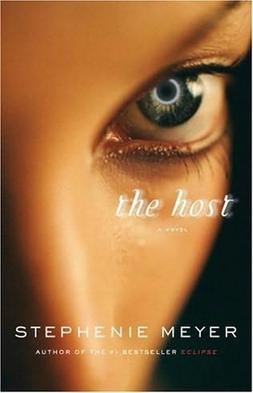 I don’t
normally like to post mean reviews, but at this point I think Stephenie Meyer
is rather too rich to
I don’t
normally like to post mean reviews, but at this point I think Stephenie Meyer
is rather too rich to
Admittedly, The Host is better than Twilight.
Significantly better, in fact. The plot actually sounds promising: an alien
invasion by parasitic creatures that attach to the spines of their hosts and
continue to live their lives as normal until virtually the whole planet is taken
over, leaving only tiny pockets of still-human resistance. The narrative is
told by one of the alien consciousnesses themselves, which is also an
interesting concept.
However, it’s
at this point that promising sci-fi originality goes out of the window and
Meyer’s compulsion to turn everything into a vapid teen romance steps in. Instead of choosing one of the
many interesting potential avenues, Meyer focuses on our alien protagonist Wanda
and her human host Mel’s inner girlish arguments, and on the fact that Wanda
appears to have inherited Mel’s love interest in her boyfriend Jared.
Wanda
decides to search for Jared and her brother Jamie, who are sheltering in a cave
in the desert. She’s taken prisoner by the community Jared and Jamie have joined,
and, now that Mel’s been taken over by the enemy, Jared is full of hatred for
her and immediately proclaims that she should be killed. Although Wanda and Mel
manage to gradually win over the trust of most of the community, Jared
is staunch in his opinion, and even hits her several times, giving her
noticeable injuries and facial scarring. She continues to try and gain his
trust by putting herself last in everything and generally acting like a
doormat, refusing to stand up for herself even to save her own life. Just as
women should do in the face of domestic violence, apparently. Thanks for that,
Meyer.
Despite the advances of attractive nice guy Ian, who has come to like Wanda for who she is now rather than Mel as she was previously and acts as protector and comforter to her, both Wanda and Mel cling to their desperate love for the man who quite literally wants to murder them for the majority of the novel. I was worried, given the fact that virtually the same situation happens in Twilight (ie. Edward literally wanting to kill Bella most of the time, and I’m-your-totally-platonic-friend Jacob doing everything for her and being off-handedly rejected for not being her true love), that the Wanda-Mel composite would end up somehow living happily ever after with the violent unpleasant Jared.
Despite the advances of attractive nice guy Ian, who has come to like Wanda for who she is now rather than Mel as she was previously and acts as protector and comforter to her, both Wanda and Mel cling to their desperate love for the man who quite literally wants to murder them for the majority of the novel. I was worried, given the fact that virtually the same situation happens in Twilight (ie. Edward literally wanting to kill Bella most of the time, and I’m-your-totally-platonic-friend Jacob doing everything for her and being off-handedly rejected for not being her true love), that the Wanda-Mel composite would end up somehow living happily ever after with the violent unpleasant Jared.
However, after telling her that, “You are the noblest, purest creature I've ever met. The
universe will be a darker place without you,” (a compliment she was clearly
fishing for from the very beginning of the novel), her friends collude to
transplant her consciousness into a vacant body (another young,
attractive female, obviously), conveniently saving her the trouble of going
through with her difficult decision to leave Mel her own body back at Wanda’s
expense. Wanda and Ian can live happily ever after, and Mel is lucky enough to
have her boyfriend back – the one who weeks ago beat her repeatedly and wanted
to kill her. Lucky, lucky Mel. But apparently he’s hot, so that’s what
matters.
So, um, yes.
Always submit meekly to your one true love, even if he beats you and threatens
to kill you, and everything will be ok, until you… get transplanted into
someone else and can have the nice guy? I’m still quite confused about the
message I’m getting from this one.
Next up: Heartstone, by C J Sansom
Tuesday, 1 April 2014
The Eyre Affair - Jasper Fforde
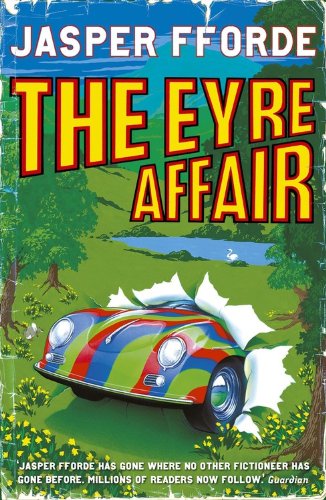
It’s set in
an alternative reality in which there are no computers, but where time travel
is simply part of an annoying job for certain types of police. Literature forms
the major part of popular culture, and we follow the heroine, Thursday, as she tries to
foil the machinations of the literary terrorist, Hades Acheron.
For someone
like me, a world in which literature is paramount and receives the celebrity
status of our real-life bands or film stars is a bizarre but fantastic idea. Once
you’re far enough into the novel to have got used to the alternative history
aspects (for instance an ongoing English-Russian Crimean War or the Welsh
Republic border skirmishes) it’s very engaging, although I’m on the fence
about some of Fforde’s more tongue-in-cheek moments. While he is genuinely very
funny – a corporation leader named Jack Schitt actually made me laugh quite
loudly in public – aspects that are obviously throw-away jokes do break the fourth wall a bit.
While I personally
found the romantic aspect of the ending unsatisfying, the parallels between
Jane Eyre’s and Thursday Next’s love lives were drawn pretty deftly and kept
subtle until the end. In general, I really enjoyed this novel – fast-paced
action, witty dialogue and an amusing narrative voice kept me gripped
throughout. I was happy to find out that it’s only the first of a seven-part
series, and look forward to reading the rest!
Next up: The Host, by Stephenie Meyer
Next up: The Host, by Stephenie Meyer
Friday, 28 March 2014
The Complete Father Brown Stories - G K Chesterton
 I can't believe it's actually taken me a month to finish this book, although in my defence I did work a lot, and it is a very long book. Each story varies between about 10-20 pages, but the complete collection weighs in at almost 800 pages.
I'm not normally a fan of short stories (the only collection I've really enjoyed is Michael Marshall Smith's What You Make It). My reason for disliking most is that they lack a sense of depth and continuity, the ability to get lost in them, which is my main motivation for reading fiction in general. The Father Brown Stories, however, obviously have continuity, because they're a set of stories about the same character. Each mini-mystery manages to set the scene so effectively that, even after 15 pages, you feel as though you've lived a full novel in the setting.
G K Chesterton also has a gift for pithy and amusing character description - a good example is:
He saw Dr Simon, a typical French scientist, with glasses, a pointed brown beard, and a forehead barred with those parallel wrinkles which are the penalty of superciliousness, since they come through constantly elevating the eyebrows. (from 'The Secret Garden')
His ability to effectively describe a character or place in one sentence in a way that really evokes them is what, for me, really sets these stories apart. The mysteries themselves vary in their complexity and convincingness, but are always solved with a wonderful sense of humanity and compassion. Most other detectives I remember reading about see the crime as a cold, set puzzle to be solved analytically and the criminal mercilessly packed off to gaol, if they haven't already been killed in some way. Father Brown, however, solves a crime by imagining the type of person who would do such a thing, putting himself in their place, and working from there. When he's discovered the criminal, he often lets them escape rather than dragging them in to face the full force of the law. He even converts a world-reknowned thief to the side of justice and remains fast friends with him throughout the series.
I wouldn't necessarily recommend reading the entire set of stories back-to-back (unfortunately I feel compelled to read books that way, but I'm not sure it's the way to get the best out of short story collections), but I'd definitely recommend them as something to dip into. Each story is atmospheric and the pervading sense of compassion gives a much more optimistic feel that that found in most detective stories.
Next up: The Eyre Affair, by Jasper Fforde
Why read fiction?
This week's Booking Through Thursday is a pretty short question:
Why do YOU read fiction?
Short, but tough to answer. For me, reading fiction is a vital function, like eating or breathing. I've been doing it for literally as long as I can remember, and if I don't have at least one fictional world available at any time, it just feels unsettling and wrong. I need to start a new book as soon as I've finished the last one, or I just a bit lost. Is that strange?
What I love about fiction is the way you get to live so many different lives, through different eyes, in a vast variety of worlds - historical, fantasy, or future ones. It pulls you out of your everyday existence. Through fiction, I've been assassins, queens, detectives, murderers, regency ladies, wizards, explorers, highwaymen, time travellers, and so many more. It expands your mind and your experiences, letting you travel the world (and a million other worlds) without leaving your seat.
So yes, that's why I read fiction.
Why do YOU read fiction?
Short, but tough to answer. For me, reading fiction is a vital function, like eating or breathing. I've been doing it for literally as long as I can remember, and if I don't have at least one fictional world available at any time, it just feels unsettling and wrong. I need to start a new book as soon as I've finished the last one, or I just a bit lost. Is that strange?
What I love about fiction is the way you get to live so many different lives, through different eyes, in a vast variety of worlds - historical, fantasy, or future ones. It pulls you out of your everyday existence. Through fiction, I've been assassins, queens, detectives, murderers, regency ladies, wizards, explorers, highwaymen, time travellers, and so many more. It expands your mind and your experiences, letting you travel the world (and a million other worlds) without leaving your seat.
So yes, that's why I read fiction.
Subscribe to:
Posts (Atom)